Overview
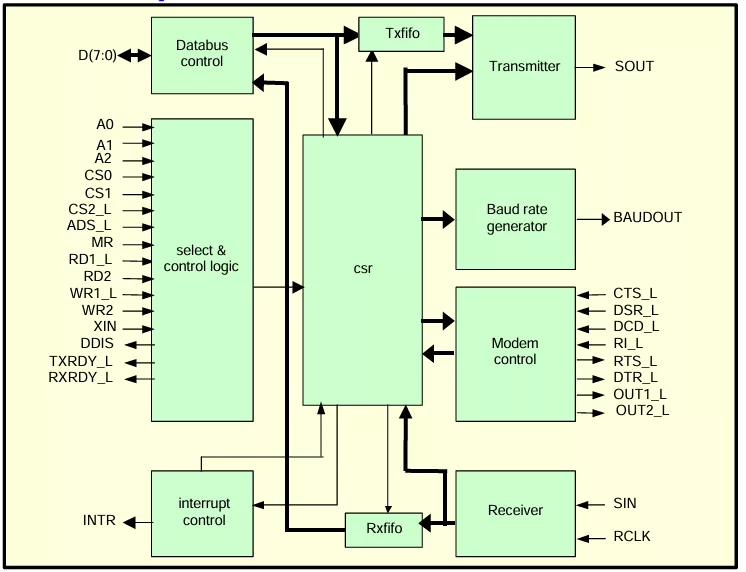
The SI40U550 IP core is a Universal Asynchronous Receiver Transmitter fully compatible with the de - facto standard 16550 UART. The SI40U550 core performs serial - to - parallel conversions on data received from a peripheral device or modem and parallel - to - serial conversion on data received from the host. The host can read the UART status at any time. The SI40U550 core includes complete modem control capability and a processor interrupt system that can be tailored to minimize software management of the communications link.
The core provides a full - featured transmitter - receiver pair, configurable by software for different speeds, character widths, parity etc. The receiver provides information status with several error indications.
The core can be placed in an alternate FIFO mode. This relieves the CPU of excessive software overhead by buffering received and transmitted characters. The receiver and transmitter FIFOs store up to 16 bytes including three additional bits of error status per byte for the receiver FIFO. In the FIFO mode, there is a selectable auto flow control feature that can significantly reduce software overload and increase system efficiency by automatically controlling serial data flow using RTS output and CTS input signals.
The SI40U550 core includes a programmable baud rate generator capable of dividing a reference clock by divisors from 1 to 65535 and producing a 16x reference clock for the internal transmitter logic. Provisions are included to use this 16x clock for the receiver logic.
DMA operation is allowed with two output signals that inform the DMA controller about when is new received data available and when the UART is able to accept new data for transmission.
Management of modem control outputs and inputs (with their associated interrupt) is included.
Learn more about UART IP core
With the increasing number of high-profile data and privacy breaches in the Internet of Things (IoT) systems, businesses and consumers have a greater awareness of the need for security when buying connected products.
The universal asynchronous receiver/transmitter (UART) is an old friend to embedded systems engineers. It's probably the first communications protocol that we learn in college. In this article, we will design our very own UART using MyHDL.
Explore how advanced packaging transforms semiconductor health and performance management, requiring deeper insights into chiplet interactions and system efficiency.
Post-quantum cryptography (PQC) is moving from theory to engineering reality. With NIST-standardized algorithms ML-KEM (FIPS 203) and ML-DSA (FIPS 204) now finalized, FPGA developers face a practical challenge: How to integrate these algorithms efficiently on resource-constrained hardware?
In today’s connected world, where data is a crucial asset in SoCs, Part V of our series explores how to protect and encrypt data, whether at rest, in transit, or in use building on our earlier blog posts of the series: Essential security features for digital designers, key management, secure boot, and runtime integrity.
Most foundries provide GPIO libraries to their fabless customers. These libraries contain different elements like supply/ground pads, analog I/Os, digital I/Os, corner cells, filler cells, power-on-reset circuits. Frequently the foundry includes cells for different voltage domains. In 40nm CMOS the IC designer can use cells for 1.8V, 2.5V and 3.3V for instance.