Ultra-short reach SerDes with 500 Gbit/s throughput
High-density, low-power SerDes IP delivering 500 Gbit/s throughput for in-package and multi-chip module interconnects, without a silicon interposer.
Overview
The Glasswing SerDes family is a set of programmable IPs designed and optimized for in-package applications. Glasswing provides high system bandwidth with low power consumption through the use of CNRZ-5-DR-EE Chord signaling and a forwarded clock architecture. Deploy Glasswing IP in multiple instances to provide efficient extended interfaces
Technology
- GlobalFoundries® 12LP process
- 0.9V and 1.2V analog supplies
- 0.8V digital supply
- Junction temperature -40 to +110 °C
- Standard flip chip technology with 150 μm bump pitch
- Tile-able layout to support high IO density
CNRZ coding
- Transmits 5 bits on 6 correlated wires:
- Balanced code leads to low SSO noise at transmitter
- Employs a reference-less receiver that is resilient to common-mode noise
- Uses a receiver that has five comparators and no decoder
- Link has excellent signal integrity properties:
- NRZ-like ISI properties
- Scalable to much higher speeds and harder
- channels
- NRZ-like EMI performance
Key features
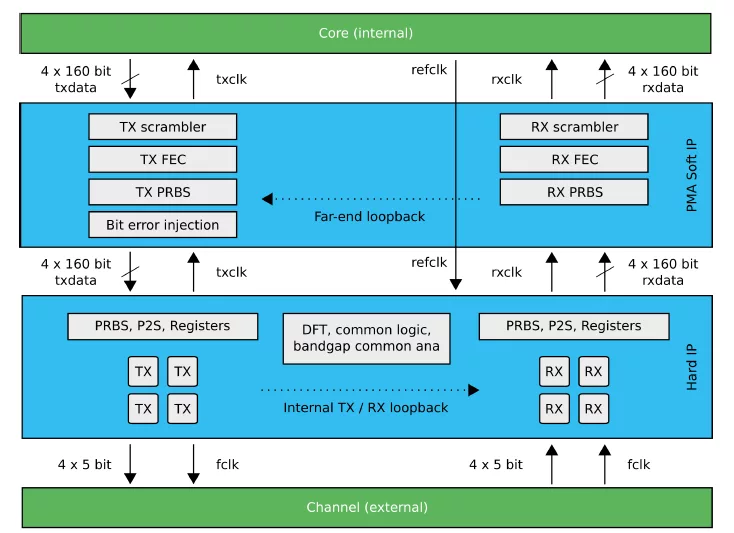
- MCM interface consisting of four 6-wire CNRZ-5 Chords, plus a shared forwarded clock (26 wires total per direction)
- No silicon interposer required due to standard 150 um bump pitch
- Maximum throughput of 500 Gbit/s in each direction
- Line rate programmable from 12.5 to 25 GBd for a throughput of 62.5 to 125 Gbit/s per Chord
- Total throughput configurable by selecting number of active Chords
- TX and RX data buses consisting of five 32-bit data words (plus clock) for each Chord
- Simple word-based TX to RX interface, RX logic recovers data alignment
- DC-coupled link with no coding/framing requirements; light-weight scrambler in PMA Soft IP ensures sufficient data toggling
- Configuration and link start-up through APB (ARM Peripheral Bus) interface
- Internal TX to RX loopback for wafer/die level test
- Configurable Bolt-On PMA soft IP for ease of use:
- Scrambler
- Bit error iniection
- Single cycle FEC to decrease BER/increase link length
- Including option to include PRBS to test impact on BER using FEC
- Far-end loopback
- RX CTLE equalization for up to 6 dB channel loss at 12.5 GHz
- TX PLL with reference clock input frequency from 100 MHz to 312.5 MHz (25 MHz supported for Test)
- Supports JTAG boundary scan (1149.1) and scan test modes (Shift/Capture and Bypass)
- Integrated diagnostics: PRBS-15 and PRBS-31 pattern generation and verification, RX EyeScope
- DFT: at-speed BIST of analog plus stuck-at scan (Capture and At-Speed)
- ATPG support
- JEDEC JESD247 Multi-wire Multi-level Interface Specification compatible
Block Diagram
Benefits
- 2x to 4x throughput at 50% or less energy consumption as compared to conventional SerDes over the same number of pins/wires
- High pin-efficiency and low power
- 208.3 Gbit/s full-duplex bandwidth per mm of die edge (500 Gbit/s for 2.4 mm of die edge)
- Supports up to 6 dB channel insertion loss at 12.5 GHz
- NRZ-like ISI and noise performance
Applications
- Multi-chip modules and short reach interposers:
- Packaging dies with dissimilar foundry processes
- Packaging of smaller dies to increase yield
- High throughput data interfaces:
- Efficient interface to off-board SerDes tiles
- Interconnection of tiled CPUs or DSPs
- Processor or switch to high bandwidth memory
- Efficient interface to optics engines
- Switch-to-switch links
What’s Included?
- Datasheet and application notes
- Hard IP standard integration views: LEF, LIB, SDC, GDSII, LVS netlist, ATPG netlist
- PMA Soft IP
- Verilog Hard IP customer model for system simulation: reference test bench
- Qualification report
- Package design and integration guidelines
Silicon Options
| Foundry | Node | Process | Maturity |
|---|---|---|---|
| GlobalFoundries | 12nm | LP | Available on request |
Specifications
Identity
Files
Note: some files may require an NDA depending on provider policy.
Provider
Learn more about Multi-Protocol PHY IP core
Coherent Logix Selects Kandou's SerDes IP for its Low-Power, High-Performance C-Programmable Processors
Kandou Announces Availability of Glasswing USR SerDes IP
Kandou Licenses Glasswing SerDes Technology to Marvell
Frequently asked questions about Multi-Protocol PHY IP cores
What is Ultra-short reach SerDes with 500 Gbit/s throughput?
Ultra-short reach SerDes with 500 Gbit/s throughput is a Multi-Protocol PHY IP core from Kandou listed on Semi IP Hub. It is listed with support for globalfoundries Available on request.
How should engineers evaluate this Multi-Protocol PHY?
Engineers should review the overview, key features, supported foundries and nodes, maturity, deliverables, and provider information before shortlisting this Multi-Protocol PHY IP.
Can this semiconductor IP be compared with similar products?
Yes. Buyers can compare this product with similar semiconductor IP cores or IP families based on category, provider, process options, and structured technical specifications.