Vendor: Dolphin Semiconductor Category: Clock Generator

Ultra low-power crystal-based 32 kHz clock generator - High temperature (Grade 1, Tj=150°)

The qOSC-XTAL-LP-32k-co.05 32 kHz crystal oscillator is an excellent choice for IoT SoC designed in TSMC 40nm ULP technology with…

TSMC 40nm ULP eFlash Pre-Silicon View all specifications

Overview

The qOSC-XTAL-LP-32k-co.05 32 kHz crystal oscillator is an excellent choice for IoT SoC designed in TSMC 40nm ULP technology with stringent power consumption constraints. It features a high accuracy 32 kHz clock for implementing RTC with calendar and timekeeping functions in the always-on domain and an ultra-low current consumption to extend the battery lifetime in sleep modes.

Applicable to automotive, industrial.
Designed for extended mission profile (aging report available).

Key features

  • High accuracy
  • Low power consumption
  • Compatible with a large range of crystals
  • Bypass mode for enabling fast testing capabilities
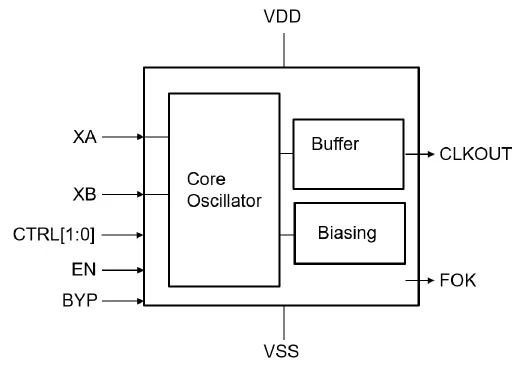
  • Frequency OK (FOK) signal indicates when frequency accuracy is reached

Block Diagram

Silicon Options

Foundry Node Process Maturity
TSMC 40nm ULP eFlash Pre-Silicon

Specifications

Identity

Part Number
qOSC-XTAL-LP-32k-co.05_TSMC_40_uLPeF
Vendor
Dolphin Semiconductor
Type
Silicon IP

Files

Note: some files may require an NDA depending on provider policy.

Provider

Learn more about Clock Generator IP core

Thorough validation: the conundrum of Pulsed latch libraries turned practical as Spinner systems

Using pulsed latches instead of flip-flops is a solution that has been thoroughly studied for its advantages in speed, density, and power consumption reduction [1] [2]. Even so, this solution has not been widely adopted by standard cell library providers because of the difficulties related to timing verifications: pulse width integrity and hold time closure. There is also a lack of EDA tools natively supporting this feature. Dolphin Integration delivers standard cell libraries based on pulsed latches (SESAME uHD libraries) that can be used in standard design flows and fully compatible with the most common EDA tools.

New Power Management IP Solution Can Dramatically Increase SoC Energy Efficiency

This Position Paper describes a family of Power Management IP solutions integrated by Dolphin Integration’s customers into their SoC to drastically improve Energy Efficiency (EE). SoC performance metric is changing, moving from pure performance metric (GHz or MIPS) to performance efficiency and minimum power consumption. This new metric, already crucial for IoT or mobile devices, is becoming key in various applications, like automotive, embedded or space.

A versatile Control Network of power domains in a low power SoC

Developing and verifying a control network in a low-power SoC is a challenging task, especially managing the different states of regulators and modes of power domains. This article first describes state-of-the-art approaches to addressing this issue, and then delves into the solution promoted by Dolphin Integration to go further, thanks to the easy and secure Maestro� solution to manage SoC power mode transitions.

Application Hardware Modeling: Selective modeling for early prediction of subsystem performances through simulation

The virtual validation of subsystem performances (Pop-up Noise, Signal-to-Noise Ratio, Power supply Noise, Power consumption...) requires the modeling and simulation of complete subsystems. Application Hardware Modeling (AHM) consists in addressing the risks of performance degradation while integrating a Silicon IP in its Integrated Circuit (IC) and this IC on its Printed Circuit Board (PCB). The selection of relevant models for a subsystem performance, along with the creation and validation of models through equivalence checking, are the basics of Application Hardware Modeling for right-on-first-pass subsystems!

Methodology to lower supply voltage of standard cell libraries

Standard cells libraries are usually designed to operate at a specific value of supply voltage referred to as “nominal voltage”. This article details the performance trade-offs in terms of power consumption and speed when decreasing power supply voltage, as well as a methodology to determine the lowest value to use.

Choosing the best Standard Cell Library without falling into the traps of traditional benchmarking methods

Assessing the comparative performances of several Standard Cell Libraries in a reliable way is a tricky project as it deals with statistical issues. The objective of this paper is dual. The first objective is to demonstrate that the « cell-by-cell » approach to compare libraries is inconsistent with actual performances results obtained after P&R of libraries on a logic circuit. The second objective is to present benchmarks and methods to compare efficiently and reliably different libraries with different architectures (e.g. CCSL versus RCSL).

Frequently asked questions about Clock Generator IP cores

What is Ultra low-power crystal-based 32 kHz clock generator - High temperature (Grade 1, Tj=150°)?

Ultra low-power crystal-based 32 kHz clock generator - High temperature (Grade 1, Tj=150°) is a Clock Generator IP core from Dolphin Semiconductor listed on Semi IP Hub. It is listed with support for tsmc Pre-Silicon.

How should engineers evaluate this Clock Generator?

Engineers should review the overview, key features, supported foundries and nodes, maturity, deliverables, and provider information before shortlisting this Clock Generator IP.

Can this semiconductor IP be compared with similar products?

Yes. Buyers can compare this product with similar semiconductor IP cores or IP families based on category, provider, process options, and structured technical specifications.

×
Semiconductor IP