Vendor: Eureka Technology, Inc. Category: UART

UART

UART

Key features

  • Functionally compatible with 16550.
  • Supports Character (16450) and FIFO (16550) mode operations.
  • Designed optimized for ASIC and PLD implementations.
  • Synchronous design with edge triggered flip-flops based on system clock input.
  • 16-byte FIFO for transmitter and receiver reduces the number of interrupt to the CPU.
  • Holding register in non-FIFO mode eliminates the need for precise synchronization between the CPU and UART.
  • Add or deletes standard asynchronous communication bits (start, stop, and parity) to or from the serial data.
  • Independently controlled transmit, receive, line status and data set interrupts.
  • Programmable baud generator divides input clock by 2 to (2 16 -1) and generates the 16X clock.
  • Synchronous input sampling timed by internal receiver clock.
  • MODEM control functions (CTS, RTS, DSR, DTR, RI, and DCD).
  • Programmable features: 5 to 8 bit characters, even/odd parities and no parity, 1, 1.5 and 2 stop bits, programmable baud rate.
  • False start bit detection.
  • Complete status reporting capabilities.
  • Line break generation and detection.
  • Internal Loopback.

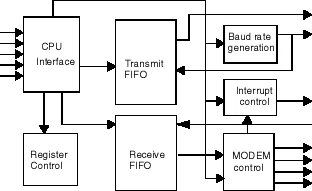
Block Diagram

Specifications

Identity

Part Number
EP600
Vendor
Eureka Technology, Inc.
Type
Silicon IP

Files

Note: some files may require an NDA depending on provider policy.

Provider

Learn more about UART IP core

Capturing a UART Design in MyHDL & Testing It in an FPGA

The universal asynchronous receiver/transmitter (UART) is an old friend to embedded systems engineers. It's probably the first communications protocol that we learn in college. In this article, we will design our very own UART using MyHDL.

Integrating Post-Quantum Cryptography (PQC) on Arty-Z7

Post-quantum cryptography (PQC) is moving from theory to engineering reality. With NIST-standardized algorithms ML-KEM (FIPS 203) and ML-DSA (FIPS 204) now finalized, FPGA developers face a practical challenge: How to integrate these algorithms efficiently on resource-constrained hardware?

How to design secure SoCs, Part V: Data Protection and Encryption

In today’s connected world, where data is a crucial asset in SoCs, Part V of our series explores how to protect and encrypt data, whether at rest, in transit, or in use building on our earlier blog posts of the series: Essential security features for digital designers, key management, secure boot, and runtime integrity.

Not all overvoltage tolerant GPIOs are the same

Most foundries provide GPIO libraries to their fabless customers. These libraries contain different elements like supply/ground pads, analog I/Os, digital I/Os, corner cells, filler cells, power-on-reset circuits. Frequently the foundry includes cells for different voltage domains. In 40nm CMOS the IC designer can use cells for 1.8V, 2.5V and 3.3V for instance.

Frequently asked questions about UART IP cores

What is UART?

UART is a UART IP core from Eureka Technology, Inc. listed on Semi IP Hub.

How should engineers evaluate this UART?

Engineers should review the overview, key features, supported foundries and nodes, maturity, deliverables, and provider information before shortlisting this UART IP.

Can this semiconductor IP be compared with similar products?

Yes. Buyers can compare this product with similar semiconductor IP cores or IP families based on category, provider, process options, and structured technical specifications.

×
Semiconductor IP