
Vendor: Syntill8 Ltd. Category: I2C / I3C

Two-Wire slave IP for use with the Mentor M8051W and M8051EW

The M2WIS adds two-wire slave capability to M8051W and M8051EW designs.

Overview

The M2WIS adds two-wire slave capability to M8051W and M8051EW designs. Use of standard synchronous design methodology makes this core simple to integrate into both ASIC and FPGA SoC designs.

Key features

  • Implementation of a two-wire slave interface, compatible with I2C bus standard
  • Compatible with I2C Fast and Fast Mode plus signalling
  • Supports seven and ten-bit addressing modes, with optional response to general call address
  • Can implement flow control with stretching
  • Supports any two-wire clock rate, independent of microcontroller clock rate
  • Integral data FIFOs minimize processor overhead required to service the link
  • Supports both interrupt-driven and polled transfers
  • Optional clock prescaler minimises power consumption whilst active
  • Power saving mode when the interface is not enabled
  • Slave select wake up feature can be used to cold start a M8051W and M8051EW microcontroller, in addition to interrupt driven wake ups
  • Binds tightly to M8051W and M8051EW external interrupt and SFR buses with no glue logic required

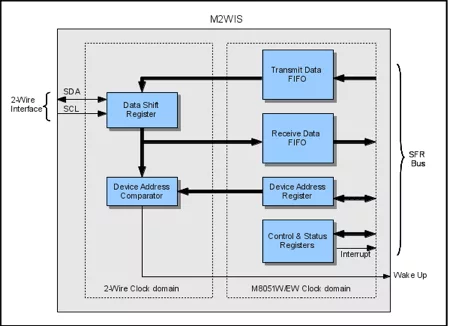
Block Diagram

Benefits

  • The M2WIS is compatible with the I2C Fast protocol. It includes hardware support for seven-bit and ten-bit device addressing modes and a general call address and address ranges. Clock stretching can be achieved under register control in order to implement flow control.
  • The core includes the following configurable peripherals as standard: Three timer/counters; Legacy UART; Watchdog timer; Two-wire master interface; Four-wire master interface; Pulse width modulator array, with ramping option.
  • All non-legacy peripherals include a configurable clock prescaler, and configurable base addresses and interrupt channels.
  • The M8051EW offers three power saving states. These are implemented by dividing the core logic into several synchronous clock domains using optional clock gates. These reduce power consumption by 75% in the idle state and to leakage levels in the stasis and powerdown states.

What’s Included?

  • VHDL '93 and Verilog 2001 RTL source code
  • VHDL and Verilog functional demonstration testbench
  • Demonstration assembler code
  • Simulation scripts for Modelsim and Cadence
  • Synopsys synthesis compile scripts and SDC timing constraint files
  • Example Mentor DFT and ATPG scripts
  • Example netlist implementation with SDF files
  • Detailed product specification and a user guide containing implementation notes

Specifications

Identity

Part Number
M2WIS - 265942
Vendor
Syntill8 Ltd.
Type
Silicon IP

Files

Note: some files may require an NDA depending on provider policy.

Provider

HQ: United Kingdom

Learn more about I2C / I3C IP core

From I2C to I3C: Evolution of Two-Wire Communication in Embedded Systems

The I2C (Inter-Integrated Circuit) Bus invented in 1980 by Philips Semiconductors (NXP Semiconductors today) was a massive step forward in simplifying communications in embedded systems. It is a simple two-wire interface for synchronous, multi-master/multi-slave, single ended serial communication. Fast forward 45 years to today and it is still widely used for attaching low speed peripheral Integrated Circuits (ICs), processors and microcontrollers. But silicon today has changed...

Maximizing the Usability of Your Chip Development: Design with Flexibility for the Future

Early in my career selling chips for Motorola Semiconductor, the ability to spin derivative microcontroller chips for a customer’s specific requirement was relatively straightforward. If the volume looked reasonable, we would tape-out a new chip with a few added features because mask costs and wafers were relatively inexpensive at the larger process nodes. The customer won by getting an MCU tailored to their specific need, and Motorola won by gaining a more committed customer plus another SKU that could be sold to other customers – boosting ROI. With the migration to higher cost FinFET nodes, those times are long gone as the economics no longer work.

MIPI CCI over I3C: Faster Camera Control for SoC Architects

Imagine a camera subsystem that responds in microseconds, consumes less power, and offers a more straightforward route to time-to-market. For SoC architects and IP integration teams, that vision is increasingly possible with MIPI Camera Control Interface (CCI) over I3C.

Frequently asked questions about I2C / I3C IP cores

What is Two-Wire slave IP for use with the Mentor M8051W and M8051EW?

Two-Wire slave IP for use with the Mentor M8051W and M8051EW is a I2C / I3C IP core from Syntill8 Ltd. listed on Semi IP Hub.

How should engineers evaluate this I2C / I3C?

Engineers should review the overview, key features, supported foundries and nodes, maturity, deliverables, and provider information before shortlisting this I2C / I3C IP.

Can this semiconductor IP be compared with similar products?

Yes. Buyers can compare this product with similar semiconductor IP cores or IP families based on category, provider, process options, and structured technical specifications.

×
Semiconductor IP