Vendor: Global UniChip Corp. (GUC) Category: HBM

TSMC CLN7FF HBM3 PHY

IGAHBMX03A is a HBM3 (High Bandwidth Memory) PHY IP compliant to the JEDEC HBM3 DRAM Specification Rev 0.95.

Controller + PHY + 1 TSMC 7nm N7FF View all specifications

Overview

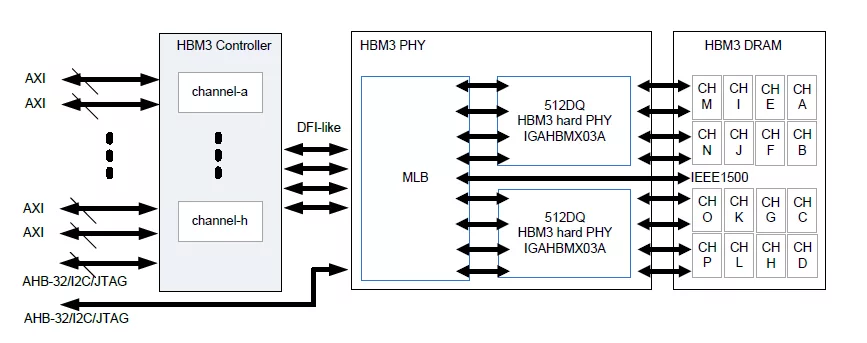
IGAHBMX03A is a HBM3 (High Bandwidth Memory) PHY IP compliant to the JEDEC HBM3 DRAM Specification Rev 0.95. Built on TSMC 7nm process node, it supports data rate up to 7200 Mbps per data pin with DFI 1:4 clock frequency ratio (controller clock : WCK = 1:4). Signal and power integrities were analyzed with GUC design flow to ensure all signal and power requirements could be met.
Key features

  • HBM3 data rate up to 7200 Mbps
  • Supports DFI-like 1:4 clock frequency ratio (controller clock : WCK = 1:4)
  • Supports only BL8
  • Supports AWORD/DWORD bus parity
  • Supports programmable parity latency, PL=0 and 2 of DQ parity function
  • Supports HBM3 data bus inversion (DBI)
  • Supports 64DQ ECC/SEV per channel
  • HBM3 hard PHY delivered as a hard macro which includes I/O, PLL, and DLL
  • Supports internal loopback and READ/WRITE BIST
  • Supports HBM3 loopback test, includes MISR and LFSR mode
  • Supports IEEE 1500 instruction
  • Supports HBM3 lane repairs with redundant pin for row/column/data
  • Supports HBM3 duty cycle adjuster (DCA ) and duty cycle monitor (DCM)

Block Diagram

Silicon Options

Foundry Node Process Maturity
TSMC 7nm N7FF

Specifications

Identity

Part Number
IGAHBMX03A
Vendor
Global UniChip Corp. (GUC)
Type
Silicon IP
Controller / PHY
Controller + PHY , PHY

Files

Note: some files may require an NDA depending on provider policy.

Provider

Learn more about HBM IP core

Reducing Avoidable Memory Trips In HBM Systems

As AI and high-performance SoCs increasingly rely on HBM, memory bandwidth alone is no longer enough to maximize performance. This article discusses why the intelligent data movement and cache efficiency are critical to unlocking the full benefits of HBM-based architectures.

Making Strong Error-Correcting Codes Work Effectively for HBM in AI Inference

LLM inference is increasingly memory-bound, and HBM cost per GB now dominates system cost. Today’s HBM stacks include short on-die ECC, which tightens binning, raises price, and locks reliability policy inside the device. This paper asks a simple question: can we tolerate a much higher raw HBM bit error rate (BER) and still keep end-to-end correctness and throughput, without changing the HBM PHY or the fixed 32B transaction size?

High Bandwidth Memory Evolution from First Generation HBM to the Latest HBM4

HBM4 is the latest generation of the High Bandwidth Memory (HBM) that has become analogous to the Artificial Intelligence (AI) boom that is everywhere in today’s world. HBM is also increasingly being used in other applications like Data centers, autonomous driving systems, servers, cloud computing just to mention few domains where bandwidth and performance in a key requirement.

Breaking the HBM Bit Cost Barrier: Domain-Specific ECC for AI Inference Infrastructure

High-Bandwidth Memory (HBM) delivers exceptional bandwidth and energy efficiency for AI workloads, but its high cost per bit, driven in part by stringent on-die reliability requirements, poses a growing barrier to scalable deployment. This work explores a systemlevel approach to cost reduction by eliminating on-die ECC and shifting all fault management to the memory controller.

Frequently asked questions about HBM Interface IP

What is TSMC CLN7FF HBM3 PHY?

TSMC CLN7FF HBM3 PHY is a HBM IP core from Global UniChip Corp. (GUC) listed on Semi IP Hub. It is listed with support for tsmc.

How should engineers evaluate this HBM?

Engineers should review the overview, key features, supported foundries and nodes, maturity, deliverables, and provider information before shortlisting this HBM IP.

Can this semiconductor IP be compared with similar products?

Yes. Buyers can compare this product with similar semiconductor IP cores or IP families based on category, provider, process options, and structured technical specifications.

×
Semiconductor IP