Overview
The SSL1 core implements SSL and/or TLS frameworks with a configurable variety of cipher suites.
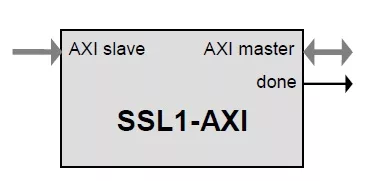
SSL1-AXI has a “lookaside” interface to the rest of system through two AXI interfaces:
•AXI3/AXI4 slave for control
•AXI3/AXI4 master for data transfer
The data stream through the control interface contains processing commands. Each command consists a pointer to the descriptor in the system memory. Descriptor contains source, destination, encryption context, processing length, and status.
The encryption context (keys, encryption state, etc.) as well as the packets are stored in the system memory attached to the AXI bus and are read and written via the master interface.
The design is fully synchronous and is available in Verilog.
Learn more about IPsec / TLS IP core
IP Cores, Inc. announces the release of the new LZR4D single-engine ultralow-latency lossless decompression core for the LZ4 format, delivering 256 bits of decompressed data per clock with less than 30 clock cycles of latency.
IP Cores, Inc. announces shipments of the FFT4T core for RF signal processing systems
IP Cores, Inc. announces shipments of the newly released PQC1 Post-Quantum Cryptography Accelerator Core that supports both ML-KEM (FIPS-203) and ML-DSA (FIPS-204).
IP Cores, Inc., California, USA had announced modifications to its true random number generator IP core, TRNG1.
IP Cores, Inc. has announced that the first shipment of the server memory encryption IP cores occurred one year ago.
IP Cores, Inc., (California, USA, http://www.ipcores.com) has announced modifications of its MSP10-512 cores that support line-speed MACsec encryption and decryption for the 400 Gbps Ethernet.