Vendor: LeWiz Communications, Inc. Category: SD / eMMC Controller

SD Card Controller

SD cards, especially the micro types, are used in many applications for storing programs, configuration data, tables, or used as external storage device.

Overview

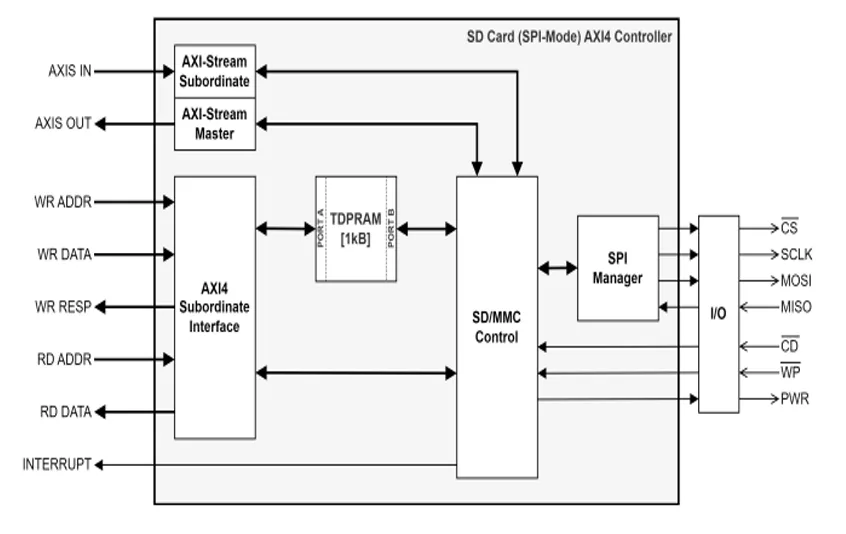
SD cards, especially the micro types, are used in many applications for storing programs, configuration data, tables, or used as external storage device. SD Controller core uses the System Peripheral Interface (SPI) to communicate with the SD-card in electronic systems. SPI is a very well-known serial communication bus. It uses few signals and does not require specialized transceivers which is an advantage for ASIC designs. Chips (whether ASIC or FPGA) can integrate LeWiz SD controller(s) for connecting to external SD-card, flash memory, and other peripherals. Other uses of LeWiz SD Controller core include read/write of stored bit files for FPGA configuration as well as software programs/data for SOC chips that are used in applications such as aerospace, storage systems, network control, etc.

Designed for short-distance inter-chip communication, the SD controller core excels in data transfers to/from SD cards and from external SPI device(s). Additionally, through the device’s master-slave interface, the SD controller core has efficient data transmissions with on-chip buffers. A single controller can simultaneously manage multiple slave peripheral devices.
Key features

  • Connects and manages of data transfers to and from SD cards and multimedia cards 
  • Built-in support for SD card booting, read/write functions, and others 
  • Supports different types of SD card response formats 
  • Easy command – response mechanism 
  • Uses SPI for reduced pin count and standard interface signaling  
  • On-chip buffers for continuous data streaming and high data transfer rate 
  • Single and multi block read/write capabilities 
  • Supports AXI4 protocol for on-chip interfacing → multiple, pipelined data transfers 
  • Also supports AXI-stream protocol for on-chip interfacing – flexible to adapt to user on-chip environment 
  • Prioritizes efficiency and latency 
  • Supports SD and MMC card types (multiple versions) 
  • Supports SD cards from many different manufacturers 
  • Supports interrupt or polling mechanisms 
  • Validated on Xilinx FPGA platforms  
  • Licensable in source or netlist format 
  • (option) Available as space flight capable core

Block Diagram

Benefits

  • Fast and efficient
  • Support 3 types of SD/MCC cards
  • Block based Read/Write
  • Designed for FPGA or ASIC
  • Support SPI mode
  • Interface: AXI4 or AXI stream

Specifications

Identity

Part Number
SPI_controller
Vendor
LeWiz Communications, Inc.
Type
Silicon IP

Files

Note: some files may require an NDA depending on provider policy.

Provider

Learn more about SD / eMMC Controller IP core

Types of Storages for Computing System-On-Chips

We are living in an age where we generate the same amount of data each year that has been generated since antiquity. Ever wondered how and where these peta /exa/zetta bytes of data are stored?

Virtual Prototyping Platform with Flash Memory

In this paper we will see how the flash memories developed using Carbon Model Studio helps to bring up an ARM® Cortex A7 flash memory sub-system with primary and secondary boot codes. Flash memories system demonstrated here can be used for early boot code and driver development for any CPU based SoC.

UFS Goes Mainstream

UniversalFlash Storage (UFS) was created for mobile applications and computer systems requiring high performance and low power consumption. These systems typically use embedded Flash based on the JEDEC standard eMMC. UFS was defined by JEDEC as the evolutionary replacement for eMMC offering significantly higher memory bandwidth. The standard builds on existing standards such as the SCSI command set, the MIPI Alliance M-PHY and UniPro as well as eMMC form factors to simplify adoption and development.

Universal Flash Storage: Mobilize Your Data

Universal Flash Storage (UFS) was created for mobile applications and computer systems requiring high performance and low power consumption. These systems typically use embedded Flash based on the JEDEC standard eMMC. UFS was defined by JEDEC as the evolutionary replacement for eMMC offering significantly higher memory bandwidth. The standard builds on existing standards such as the SCSI command set, the MIPI Alliance M-PHY and UniProSM as well as eMMC form factors to simplify adoption and development.

Frequently asked questions about SD / eMMC Controller IP cores

What is SD Card Controller?

SD Card Controller is a SD / eMMC Controller IP core from LeWiz Communications, Inc. listed on Semi IP Hub.

How should engineers evaluate this SD / eMMC Controller?

Engineers should review the overview, key features, supported foundries and nodes, maturity, deliverables, and provider information before shortlisting this SD / eMMC Controller IP.

Can this semiconductor IP be compared with similar products?

Yes. Buyers can compare this product with similar semiconductor IP cores or IP families based on category, provider, process options, and structured technical specifications.

×
Semiconductor IP