Vendor: Alma Technologies Category: Image Conversion

Scalable Ultra-High Throughput JPEG-LS Encoder

The UHT-JPEGLS-E core is a JPEG-LS encoder, compliant to ISO/IEC IS 14495-1 | ITU-T Recommendation T.87 standards.

Overview

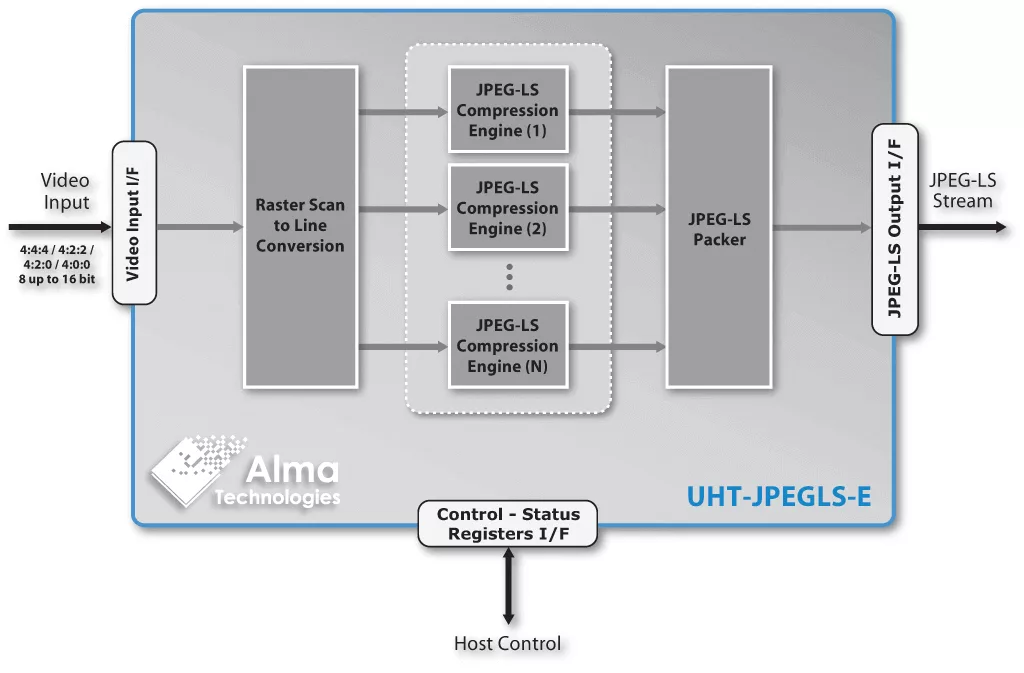
The UHT-JPEGLS-E core is a JPEG-LS encoder, compliant to ISO/IEC IS 14495-1 | ITU-T Recommendation T.87 standards. It supports encoding of 4:4:4, 4:2:2, 4:2:0 and 4:0:0 (grayscale) video streams, in 8 up to 16 bits sample depths. The core is a standalone and high-performance JPEG-LS encoder, designed for enabling ultra-high frame rate SD and HD encoding, and Ultra HD video encoding (4K/8K and beyond), even in low-end ASIC or FPGA silicon. The UHT-JPEGLS-E is available for ASIC or AMD-Xilinx, Efinix, Intel, Lattice and Microchip FPGA and SoC based designs.

JPEG-LS is based on the LOCO-I (Low Complexity-Lossless Compression for Images) image compression algorithm, which uses a non-linear predictive scheme with rudimentary edge detecting capability, based on the four nearest –causal- neighbours (left, upper left, upper and upper right) and an entropy encoder using adaptively selective Golomb-type codes. The low complexity scheme of JPEG-LS is based on the assumption that prediction residuals follow a two-sided geometric distribution and the fact that Golomb-codes are optimal for geometric distributions, thus the modeling and coding units are matching.

UHT-JPEGLS-E is very easy to use and integrate in a system. It requires minimal host intervention as it only needs to be programmed once per video sequence. Once programmed, it can encode an arbitrary number of video frames without the need of any further intervention or assistance by the host system CPU.

UHT-JPEGLS-E accepts the uncompressed raw video data in interleaved scan format. It outputs standalone, standard compliant, JPEG-LS byte stream format. No post processing on the output stream, other than (as examples) saving, muxing, or transmitting, is required by the host. The output JPEG-LS byte stream can be decoded, as is, by any corresponding ISO/IEC IS 14495-1 | ITU-T Recommendation T.87 compliant decoder.

Key features

  • ISO/IEC IS 14495-1 JPEG-LS T.87 Compliant and Standalone Operation
    • Full compliance to the ISO/IEC IS 14495-1 JPEG-LS specification
    • Programmable image dimensions from 8 x 8 up to 64k x 64k
    • 4:4:4, 4:2:2, 4:2:0 and 4:0:0 single scan encoding
    • 8 up to 16 bits per sample depth encoding
    • Programmable point transform
    • Programmable local gradient thresholds
    • ISO/IEC IS 14495-1 compliant JPEG-LS byte stream output
    • CPU-less, complete and standalone operation
  • Advanced JPEG-LS Implementation
    • Ultra-high throughput in low-end silicon
    • Low native encoding latency
    • On-chip memory implementation
  • Easy Implementation and Verification
    • Extensive documentation
    • Bit Accurate Model (BAM) with optional Test Vector generation functionality
    • Self-checking testbench environment
    • Sample BAM scripts
    • Synthesis scripts
    • Simulation scripts
    • Place & Route scripts for FPGAs

Block Diagram

What’s Included?

  • Clear-text RTL sources for ASIC designs, or pre-synthesized and verified Netlist for FPGA and SoC devices
  • Release Notes, Design Specification and Integration Manual documents
  • Bit Accurate Model (BAM) and test vector generation binaries, including sample scripts
  • Pre-compiled RTL simulation model and gate-level simulation netlist for the FPGA Netlist license
  • Self-checking testbench environment sources, including sample BAM generated test cases
  • Simulation and sample Synthesis (for ASICs) or Place & Route (for FPGAs) scripts

Specifications

Identity

Part Number
UHT-JPEGLS-E
Vendor
Alma Technologies
Type
Silicon IP

Files

Note: some files may require an NDA depending on provider policy.

Provider

HQ: Greece

Learn more about Image Conversion IP core

Enabling AI Vision at the Edge

Computer vision has made tremendous advances in the last several years due to the proliferation of AI technology. The intersection of big data and massive parallel computing changed the way in which machines are programmed to understand unstructured 2D and 3D data, such as video feeds from cameras.

Nextreme Structured ASICs: An alternative for designing cost-optimized ARM926EJ processor-based embedded systems

Traditional IC design options that embedded system designers have had to choose from include fixed hardware devices such as standalone microprocessors, microcontrollers and ASSPs or configurable hardware devices such as FPGAs and cell-based ASICs. In this paper we present a new design option called Nextreme Structured ASICs which provide embedded system designers with a compelling alternative to custom embedded system design.

Generating High Speed CSI2 Video by an FPGA

In this article, we show how fast video streams conforming to MIPI CSI2 rev2.0 over MIPI DPHY rev1.2 can be generated, using VLSI Plus’ SVTPlus-CSI2-F IP core, with simple off-FPGA analog front-end. The high bit rates can be achieved with a relatively slow FPGA clock frequency, trading off FPGA resources for simple timing closure.

Viewpoint: Opportunity to win on different design fronts

Beyond pure process scaling which is necessary to meet today's price, power, and performance goals, chip designers have to grapple with tighter integration and product performance specialities in areas such as integrated power management, image sensing, application-specific data conversion, and enhanced display drivers.

Frequently asked questions about image conversion IP cores

What is Scalable Ultra-High Throughput JPEG-LS Encoder?

Scalable Ultra-High Throughput JPEG-LS Encoder is a Image Conversion IP core from Alma Technologies listed on Semi IP Hub.

How should engineers evaluate this Image Conversion?

Engineers should review the overview, key features, supported foundries and nodes, maturity, deliverables, and provider information before shortlisting this Image Conversion IP.

Can this semiconductor IP be compared with similar products?

Yes. Buyers can compare this product with similar semiconductor IP cores or IP families based on category, provider, process options, and structured technical specifications.

×
Semiconductor IP