Do You Really Know RapidIO?
Eric Esteve
Intel is discontinuing the intellectual property (IP) for RapidIO I and RapidIO II Intel offers two distinct Intel® FPGA IPs for …
Intel is discontinuing the intellectual property (IP) for RapidIO I and RapidIO II
Intel offers two distinct Intel® FPGA IPs for RapidIO:
For device support details, such as lane rates, link widths, and speed grades, refer to the RapidIO Intel® FPGA IP user guides.
A significant portion of the wireless industry adopts the RapidIO standard as a high-speed interconnect. The RapidIO standard is typically used between digital signal processors as well as between the control plane processors and memory. RapidIO is also gaining acceptance as a backplane interconnect due to its adoption of widely used standards for the electrical characteristics of the physical media attachment (PMA), such as XAUI or CEI for up to 6.25 Gbaud data rate. Intel® FPGAs are also capable of supporting RapidIO Gen3 data rates.
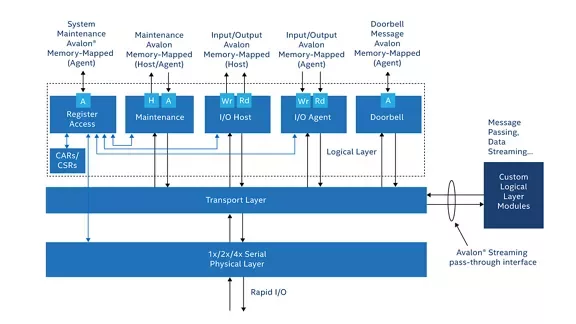
For a system-level integration-ready solution, you can save several months of design time by selecting all RapidIO layers—including features, such as address translation as well as simple Avalon® Memory-Mapped (Avalon-MM) and Avalon® Streaming (Avalon-ST) FIFO interfaces.
Protocol Solution
One of the images shows an example of a system built using the Platform Designer with a Nios® II soft embedded processor as a processing element. The program memory can include “boot code” for system-level enumeration of the various endpoints. The program also configures the capability address registers of the endpoints and the Intel® FPGA IP function.
Note: some files may require an NDA depending on provider policy.

RapidIO Intel® FPGA IP is a RapidIO IP core from Altera listed on Semi IP Hub.
Engineers should review the overview, key features, supported foundries and nodes, maturity, deliverables, and provider information before shortlisting this RapidIO IP.
Yes. Buyers can compare this product with similar semiconductor IP cores or IP families based on category, provider, process options, and structured technical specifications.