Overview
Advanced 3GPP compliant equalisation, double uplink performance and spectral efficiency with this 5G NR Uplink Physical Shared Channel solution
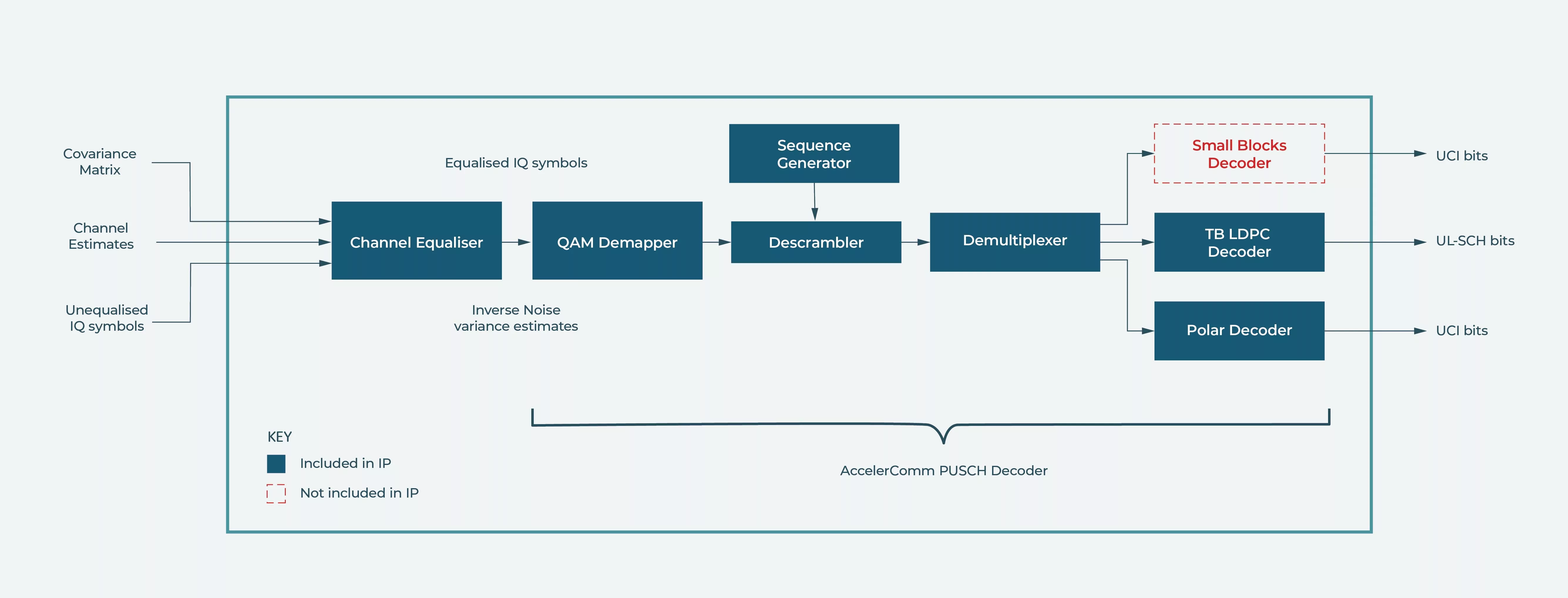
AccelerComm’s PUSCH Equaliser IP product offers a complete high-performance 3GPP compliant PUSCH channel for a gNB, bringing on average 29% savings in infrastructure power and equipment cost for typical private networks and $193M increase in Net Present Value for typical Fixed-Wireless Access networks.
MIMO equalisation
MIMO equalisation is fundamental in 5G NR to tackle co-channel interference imposed by multiple transmissions in the time, frequency and space domains, to achieve ever higher spectral efficiency and reduce cost per bit for 5G applications in sub 6GHz and mmWave. To hit a ‘sweet spot’ between computational complexity and spectral efficiency, many challenges must be overcome. AccelerComm has introduced advanced 5G NR MIMO equalisation techniques based on state-of-the-art algorithms such as MMSE-IRC, to enable higher spectral efficiencies at both low and high SNRs. Delivering a 3dB improvement in uplink receive sensitivity for a deployed gNodeB solution, these techniques can be deployed in 5G small cell, macro cell and satellite applications.
Integrating and validating the whole set of signal processing tasks of the Physical Uplink Shared Channel (PUSCH) channel requires a significant investment in engineering resource. Trusted by Tier-1 technology companies and leading semiconductor companies with our 5G NR IP, AccelerComm has built up a strong product portfolio and expertise in the field of the L1 physical layer. With LDPC, Polar, PDSCH Encoder, PUSCH Decoder and now PUSCH equaliser (MIMO equalisation), AccelerComm’s latest IP product offers benefits of UCI over PUSCH and improved throughput and dB gain for the PUSCH channel, while greatly reducing the risks and providing market-leading solutions and faster time to market for FPGA and ASIC 5G platforms.
Learn more about Channel Coding IP core
AccelerComm will support development of one of Europe’s first regenerative 5G satellite base stations for Low Earth Orbit networks
Across the two successive engagements, AccelerComm supported Eclipse in defining the physical-layer architecture for its next-generation spacecraft, spanning both its direct-to-device and broadband payload families.
Airbus UpNext SpaceRAN aims to demonstrate how 5G technology can be extended beyond terrestrial networks, delivering interoperable, standardized, and globally available connectivity for commercial, defense, and governmental applications. As part of a consortium of industry partners assembled by Airbus, AccelerComm is supplying a critical 5G physical layer (PHY) solution that enables communications signal processing on-board software-defined satellites.
This project will tighten the integration of the two companies' technologies so that they can be offered as a complete package to satellite manufacturer and operator customers.
The capital will be used to further develop and accelerate deployments of the company’s 5G satellite communications products and technology that enable Direct-to-Device (D2D) communications between phone handsets and space-based satellite networks.
One question we get asked by most of our customers when they are designing our technology into their systems is what is the processing throughput? It turns out that the answer to this question is a little more complex than you might think. It’s tempting to simply state the peak throughput of the component in question, but that can sometimes be quite misleading.