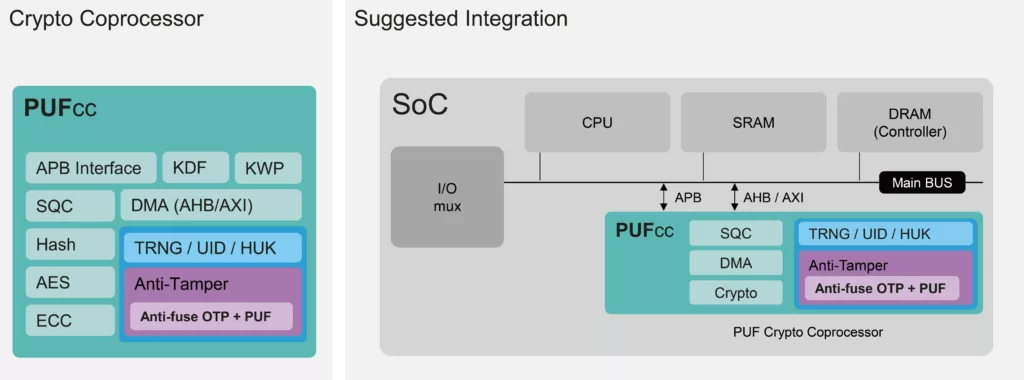
Crypto Coprocessor
PUFcc is a novel high-security Crypto Coprocessor.
Overview
PUFcc is a novel high-security Crypto Coprocessor. Compared to traditional security SoC design (embedded HSM with secure core or discrete crypto components), PUFcc can provide a much easier to adopt hardware RoT with less vulnerability. As a result, PUFcc quickly improves the security level for any system without additional loading on the processor core or operating system.
The security boundary for PUFcc is quite robust, based on physical separation of hardware, with less vulnerability than a software-only barrier. The on-board PUF is a naturally well-protected source of static entropy, suitable for SoC architects to build a system’s key hierarchy using established key generation and management procedures. In addition, PUFcc’s crypto engines can perform a wide variety of secure operations, such as key exchange, secure boot or TLS (public key validation and signing), authentication (MAC), or key wrapping (again based on the natural randomness inherent to the PUF) and store said wrapped keys to external memory.
Key features
- Comprehensively support all CPU architectures
- Crypto engine collective, consisting of private key cipher, message authentication code, hash, and key derivation functions that are NIST CAVP certified and OSCCA standards compliant
- Key wrapping function aiding the export of keys for external use
- Public-key coprocessor, supporting all elliptic curve cryptography functions
- Four 256-bit hardware PUF fingerprints with self-health check
- Up to 128kb mass production OTP with built-in instant hardware encryption
- Comprehensive anti-tamper designs implemented through physical and RTL designs
- High-speed, low-power and pre-harden true random number generator
- APB control interface with secure/non-secure access privilege
- AXI/AHB interface for direct memory access
- Process Availability
- Scalable down to 3nm, and continuous development
- Available across worldwide foundries
- Security Features
- PSA Certified Level 2 Ready
- Riscure certified
- Resistant to physical attacks, including decapsulation, microscope imaging, probing, reverse engineering, etc.
- Controller/Interface
- Standard APB Control Interface
- AXI/AHB interface for direct memory access for various SoC designs
- Secure OTP Wrapper (Factory test, user, RMA debug, Read/Write, Read-Only, and Non-accessible modes)
- Autoload interface for system calibration upon powering on to support product LFM, secure boot, secure debug, etc.
- IEEE1687 JTAG testing interface
- XiP (PUFxip) package available
- External flash encryption (PUFenc) package available
- Memory Built-In Self Repair/Test Data Register/Secure Debug access through external Test Access Port
- PUF-based Secure Storage
- Up to 128Kb OTP
- Various memory maps configurations to fulfill different usage scenarios
- Dummy insertion read based on entropy from TRNG
- Scrambler based on PUF value securely stores keys, unique to each PUFrt
- Stored values cannot be changed/deleted
- NIST SP800-90C Compliant TRNG
- Pre-harden and calibration free
- Ultra-fast initial time/stabilization (<100us)
- High-speed throughput (> 160 Mbits/sec)
- Ultra-low power
- Compliant with NIST SP800-22 and NIST SP800-90B with IID/restart test NIST
- SP800-90A DRBG for >1Gbps random number generation available as optional accessory
- PUF-based Unique ID
- With ideal minimum entropy (1)
- Unpredictable randomness and uniqueness for UID with 50% Hamming weight and Hamming distance
- On-demand keys for on-chip secret and off-chip ID generation
- Optimal reliability with lifetime zero Bit Error-Rate (BER)
- Robustness of working under different circumstances (Temp: -40~175°C)
- Key Derivation Function (KDF)
- KBKDF (CTR/FB)
- PBKDF
- KDF_HASH
- RFC4306/2246/4346
- Key Wrapping (KWP)
- NIST SP800-38F key wrapping engine
- Public Key Cryptography (PKC)
- NIST standard Elliptic Curves
- ECDSA/ECDH/RSA
- Message Authentication Code Engine (MAC)
- CMAC/HMAC/CBCMAC/GHASH
- POLY1305
- Private Key Cryptography
- NIST SP800-SP38A/B/C/D/E supported
- AES128/192/256
- ChaCha20
- SM4
- ECB/CFB/OFB/CBC/CTR/CCM/GCM/XTS modes supported
- Secure Hash Functions
- MD5/SHA1
- SHA224/256/384/512
- SHA512_224/_256
- SM3
- Software
- Software stack that includes firmware, API, and Mbed-TLS drive
- SM2
- Comprehensive Anti-Tamper Designs
- Against Invasive Attack
- Intrinsically physical security
- Data scrambling and shuffling
- Against voltage contrast attack
- Against Semi-Invasive Attack
- Metal shielding
- Security-oriented IP layout
- Simulation circuit protection
- Interface protection
- Output data FI detection
- Against Non-Invasive Attack
- Pin protection on address/mode pin and data
- Access control and Zeroization
- Unified power design
- Power floating detection
- Built-in secure repair
- Post-masking for UID and Key Storage to prevent malicious access
- Against Invasive Attack
Block Diagram
What’s Included?
- Datasheet
- Release Notes
- Integration Guidelines
- Timing .lib file
- LEF
- Phantom GDS
- Simulation Environment and PUF-based hard-macro behavior model
- RTL: with Synthesis Script
- Application note (memory-mapped register/FW/API)
- FW/API Reference code
- Hard Macro Release Note
- Testing Methodology
- Test Bench
Specifications
Identity
Videos
Files
Note: some files may require an NDA depending on provider policy.
Provider
Learn more about Security Coprocessor IP core
Software-Defined Everything doesn't mean Software-Only Security
TPM 2.0-Ready: Top Security with PUFcc
Embracing a More Secure Era with TLS 1.3
Standardized PUF-based Solution for Device eID
Security coprocessor ties to PCI Express
Frequently asked questions about Security Coprocessor IP cores
What is Crypto Coprocessor?
Crypto Coprocessor is a Security Coprocessor IP core from PUFsecurity listed on Semi IP Hub.
How should engineers evaluate this Security Coprocessor?
Engineers should review the overview, key features, supported foundries and nodes, maturity, deliverables, and provider information before shortlisting this Security Coprocessor IP.
Can this semiconductor IP be compared with similar products?
Yes. Buyers can compare this product with similar semiconductor IP cores or IP families based on category, provider, process options, and structured technical specifications.