
Programmable LDO voltage regulator (output voltage 2.5 V to 2.7 V)
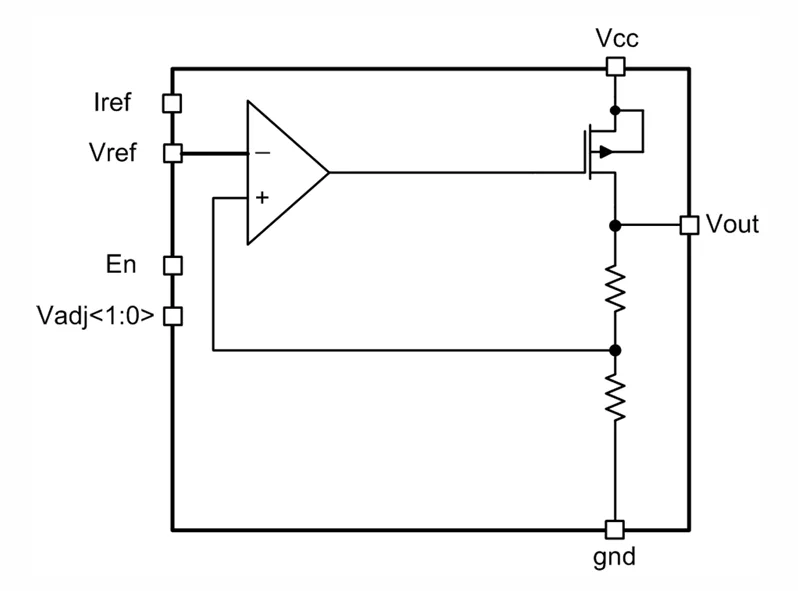
The voltage regulator consists of differential amplifier which compares reference voltage with voltage from feedback divider.
Overview
The voltage regulator consists of differential amplifier which compares reference voltage with voltage from feedback divider. It adjusts the impedance of the pass PMOS transistor for stabilization of output voltage at the set level. Input voltage: 2.7...3.6 V. Output voltage: 2.5...2.7 V. Maximum load current: 100 mA.
The block is fabricated on iHP SiGe BiCMOS 0.25 um (SGB25V) technology.
Key features
- iHP SGB25V
- Low drop out
- Low current consumption
- Output voltage digital adjustment
- Portable to other technologies (upon request)
Block Diagram
Applications
- Supply voltage sensitive circuits
What’s Included?
- Schematic or NetList
- Abstract model (.lef and .lib files)
- Layout view (optional)
- Behavioral model (Verilog)
- Extracted view (optional)
- GDSII
- DRC, LVS, antenna report
- Test bench with saved configurations (optional)
- Documentation
Specifications
Identity
Files
Note: some files may require an NDA depending on provider policy.
Provider
Learn more about LDO Voltage Regulator IP core
Power Management for Internet of Things (IoT) System on a Chip (SoC) Development
Power management poses challenges
Tradeoffs of LDO Architectures and the Advantages of Advanced Architecture "Capless" LDOs
Key considerations and challenges when choosing LDOs
Introduction to Low Dropout (LDO) Linear Voltage Regulators
Frequently asked questions about LDO Voltage Regulator IP cores
What is Programmable LDO voltage regulator (output voltage 2.5 V to 2.7 V)?
Programmable LDO voltage regulator (output voltage 2.5 V to 2.7 V) is a LDO Voltage Regulator IP core from NTLab listed on Semi IP Hub.
How should engineers evaluate this LDO Voltage Regulator?
Engineers should review the overview, key features, supported foundries and nodes, maturity, deliverables, and provider information before shortlisting this LDO Voltage Regulator IP.
Can this semiconductor IP be compared with similar products?
Yes. Buyers can compare this product with similar semiconductor IP cores or IP families based on category, provider, process options, and structured technical specifications.