Vendor: Siliconarts, Inc. Category: GPU

Path tracing/Ray tracing accelerator

RayCore Lite IP is designed based on MIMD architecture.
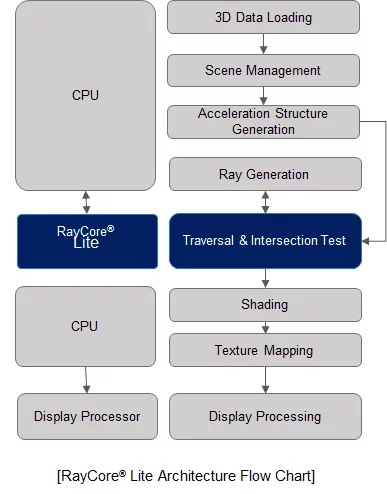
Overview

RayCore Lite IP is designed based on MIMD architecture. This approach enables more efficient execution of independent parallel tasks – each ray is regarded as an independent instruction. Due to this advantage, RayCore Lite with its ray tracing pipeline maintains ray tracing performance, regardless of ray coherence and scene characteristics and consequently supports real-time ray tracing. Accounting for most of the computations in Ray tracing graphics is part of the T&I (Traversal & Intersection test). Customers can achieve significant performance gain by replacing the tracking of the T&I portion with RayCore Lite, which already has a ray tracking solution.

Key features

  • Powerful Path Tracing Acceleration GPU IP Solution
  • ‘Unified’ Traversal and Intersection Test
  • Based on High Performance MIMD Architecture
  • Highly Applicable for Servers and High End GPU Chips

Block Diagram

Benefits

  • H/W (T&I) Performance : 760 Mray/s (16 cores @ 190 MHz) = The Performance is an ideal performance based on the clock speed and the required clock cycles to complete the logic pipeline
  • Effective Performance: 160 Mray/s = Effective Performance is bachmarked based on Intel Arria 10 PAC Card with Cornell Box.

Specifications

Identity

Part Number
RayCore Lite GPU IP
Vendor
Siliconarts, Inc.
Type
Silicon IP

Files

Note: some files may require an NDA depending on provider policy.

Provider

Learn more about GPU IP core

Tape-out Risk in the Age of Edge AI: The Case for GPU IP

A full SoC tape-out at 5nm approaches $400M in fully loaded, non-recurring engineering and mask costs. At 3nm, estimates push past $600M. Every IP block on that die is a commitment to a set of assumptions about what the silicon will need to do. In AI, those assumptions have a shorter shelf life than they used to.

What Does a GPU Have to Do With Automotive Security?

The automotive industry is undergoing the most significant transformation since the advent of electronics in cars. Vehicles are becoming software-defined, connected, AI-driven, and continuously updated. This evolution brings extraordinary new capability – but it also brings greater levels of cybersecurity and functional-safety risks.

How Alternate Geometry Processing Enables Better Multi-Core GPU Scaling

Scaling GPU performance across multiple cores sounds simple in theory: add more cores, get more performance. In practice, it’s one of the toughest challenges in graphics architecture. While some workloads scale well thanks to their independent nature, some workloads, especially geometry processing, introduce order dependencies that make linear performance scaling a tricky problem to solve for every GPU architecture in the industry.

Frequently asked questions about GPU IP cores

What is Path tracing/Ray tracing accelerator?

Path tracing/Ray tracing accelerator is a GPU IP core from Siliconarts, Inc. listed on Semi IP Hub.

How should engineers evaluate this GPU?

Engineers should review the overview, key features, supported foundries and nodes, maturity, deliverables, and provider information before shortlisting this GPU IP.

Can this semiconductor IP be compared with similar products?

Yes. Buyers can compare this product with similar semiconductor IP cores or IP families based on category, provider, process options, and structured technical specifications.

×
Semiconductor IP