Vendor: Mixel, Inc. Category: MIPI PHY

MIPI M-PHY IP

The MIPI M-PHY is a high-frequency low-power, Physical Layer IP that supports the MIPI® Alliance Standard for M-PHY.

Overview

The MIPI M-PHY is a high-frequency low-power, Physical Layer IP that supports the MIPI® Alliance Standard for M-PHY. The IP can be used as a physical layer for many applications, connecting flash memory-based storage, cameras and RF subsystems, and for providing chip-to-chip inter-processor communications (IPC).

It supports MIPI UniPro and JEDEC Universal Flash Storage (UFS) standard. By using efficient BURST mode operation with scalable speeds, significant power savings can be obtained. Selection of signal slew rate and amplitude allows reduction of EMI/RFI, while maintaining low bit error rates.

Key features

  • Complies with MIPI Standard for M-PHY, Draft Specification v0.90.
  • Dual-simplex point-to-point interface with ultra low voltage differential signaling
  • Slew-rate control for EMI reduction
  • Supports all HS modes (GEAR 1-2)
  • Supports all Type-I LS modes (GEAR 0-7)
  • Supports Type I & II LS mode
  • 1-3Gbps data rate in HS mode
  • 0.01-576Mbps data rate in LS mode
  • Suitable for copper and optical media
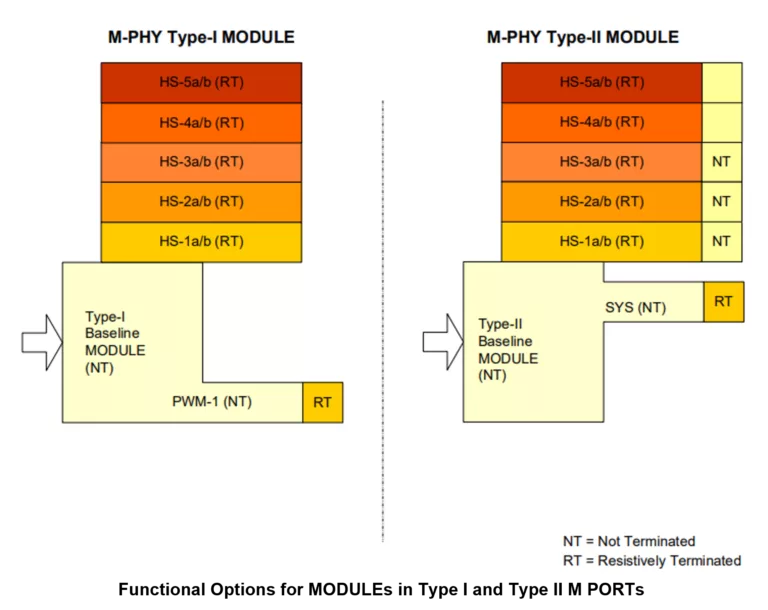
  • Modular design to allow for all possible configurations
  • Low power dissipation
  • Uses "Legorithmic" approach to allow for all possible configurations

Block Diagram

Specifications

Identity

Part Number
MXL-MPHY
Vendor
Mixel, Inc.
Type
Silicon IP

Standards & Interfaces

MIPI PHY
MIPI M-PHY

Files

Note: some files may require an NDA depending on provider policy.

Provider

HQ: USA

Learn more about MIPI PHY IP core

MIPI M-PHY takes center stage

The curtain is up and the M-PHY specification is taking center stage, positioned to handle the many different roles required for a faster, more reliable, physical interface layer (PHY Layer) on mobile devices.

Dual Mode C-PHY/D-PHY: Enabling Next Generation of VR Displays

For many years, Virtual Reality (VR) and Augmented Reality (AR) were strongly linked to gaming and entertainment applications. Today, the VR/AR and their combined version, Mixed Reality (MR), have their applications extended to other domains like healthcare, military, education, manufacturing, retail, marketing and advertising. What are the challenges for next generation VR displays? What makes the MIPI interfaces the best fit for VR/AR/MR applications?

Demystifying MIPI C-PHY / DPHY Subsystem

The newest member of the MIPI® PHY family, the C-PHY, arrived in October 2014 to a mixture of excitement and apprehension. How would this new C-PHY compare to the MIPI D-PHY and M-PHY®? What would differentiate the C-PHY, and would it be compatible enough with the D-PHY so that both could coexist in a hybrid subsystem? Now, years later, the answers are clear.

Can MIPI and MDDI Co-Exist?

Since MIPI and MDDI standards both target interfaces to cameras and displays on mobile devices, are two separate standards really needed?

Frequently asked questions about MIPI PHY IP

What is MIPI M-PHY IP?

MIPI M-PHY IP is a MIPI PHY IP core from Mixel, Inc. listed on Semi IP Hub.

How should engineers evaluate this MIPI PHY?

Engineers should review the overview, key features, supported foundries and nodes, maturity, deliverables, and provider information before shortlisting this MIPI PHY IP.

Can this semiconductor IP be compared with similar products?

Yes. Buyers can compare this product with similar semiconductor IP cores or IP families based on category, provider, process options, and structured technical specifications.

×
Semiconductor IP