Vendor: Synopsys, Inc. Category: I2C / I3C

MIPI I3C Controller and Target Functionality

The MIPI I3C Controller IP is compliant with the I3C specification and delivers higher bandwidth and scalability for integrating …

Overview

The MIPI I3C Controller IP is compliant with the I3C specification and delivers higher bandwidth and scalability for integrating multiple sensors into mobile, automotive and IoT system-on-chips (SoCs) that previously depended on I2C. The support for in-band interrupts within the 2-wire interface provides a significantly lower pin count, simplifying board design and reducing power and cost. The I3C electrical characteristics enable faster data rates and lower power consumption than I2C by enabling push-pull mode of operation vs open drain mode in the Clock line and a large portion of the data line. The introduction of Common Command Codes (CCCs) help standardize the communication across controller and targets from different vendors.

The Target IP is backward compatible with I2C, allowing designers to future-proof their design whilst still interoperating with legacy and new sensors on a single I3C bus. The standard-based ARM® AMBA® Advanced Peripheral Bus (APB) connects the IP to the rest of the SoC while the bus is connected to the register interface and the Direct Memory Access (DMA) interface, offering easy IP integration.

The Target-Lite IP allows for low complexity and cost implementation intended for simple processor-less sensors/actuators to communicate/update their state with a host controller.

Low-power management features such as clock gating enable energy-efficient sensors and SoC designs while the configurable transaction and data buffering features allow performance versus cost trade-offs for the target application.

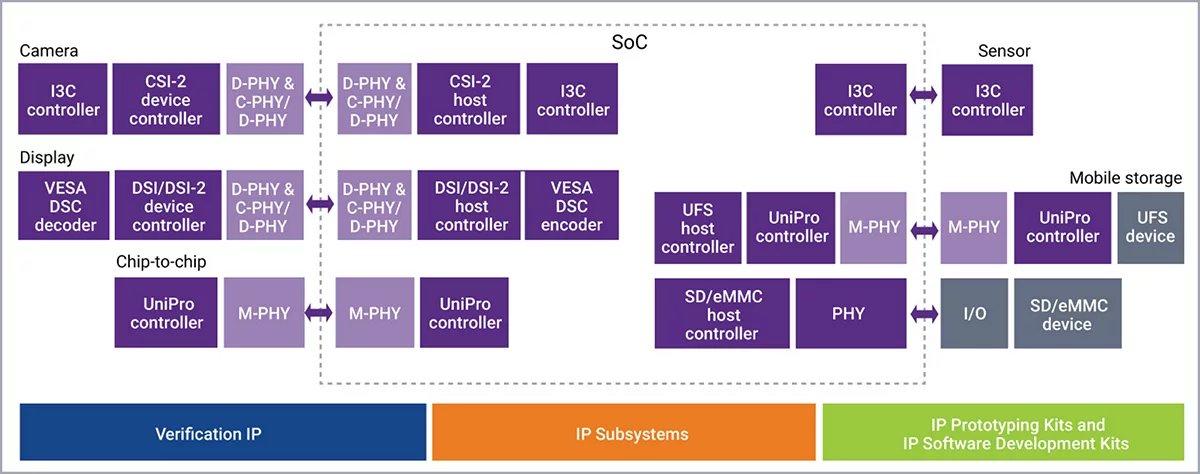
The MIPI I3C Controller IP with the vendor’ silicon-proven MIPI CSI-2 Controller, D-PHY, verification IP and IP Prototyping Kit enable designers to have a complete image sensor interface solution.

Besides acting as a sensor interface, the I3C IP natively supports the JEDEC JESD403-1 specification for DDR5 Sideband communication to connect the Host SoC with PMICs, RCDs and Temperature sensors on RDIMMs.

System Management standards such as Management Component Transport Protocol (MCTP) can be enabled as a layer above the I3C IP.

The vendor has digital IP, IO pads and VIP to make a comprehensive offering for I3C.
Key features

  • Supports MIPI I3C v1.1.1 specification
  • Compliant with MIPI I3C Conformance Test Suite (CTS) v1.0
  • Supports the MIPI I3C Host Controller Interface and DDR5 JEDEC JESD403-1 and System Management MCTP specifications
  • Supports SDR, HDR-DDR, HDR-TSL/TSP; all data rates up to 33.4 Mbps
  • Supports controller, secondary controller and target IP roles
  • Supports In-band interrupts within the 2-wire interface
  • Dynamic address allocation
  • Hot-join capability
  • Vendor-specific Command Codes
  • Target Reset Pattern
  • Asynchronous Timing Control Mode 0
  • Virtual targets
  • Grouped addressing
  • Low power management support
  • 32-bit AMBA APB secondary interface to an application processor
  • Configurable external SRAM access
  • Peripheral flow control mode and DMA handshaking interface support
  • Backward compatible with the I2C target IP devices per I3C specification
  • Fully interoperable with third-party I3C controllers and target IP solutions
  • Proven interoperability with Synopsys I3C IO pads

Block Diagram

Specifications

Identity

Part Number
dwc_mipi_i3c
Vendor
Synopsys, Inc.
Type
Silicon IP

Files

Note: some files may require an NDA depending on provider policy.

Provider

Learn more about I2C / I3C IP core

Context Based Clock Gating Technique For Low Power Designs of IoT Applications - A DesignWare IP Case Study

This paper discusses about the intelligent low power techniques such as context based clock gating and how they are useful for IoT applications. It also describes how it improves the overall power efficiency of the system. The power statistics shared shows how the overall idle power and functional power consumption is significantly reduced. Further we discuss about how it can be combined with few other low power techniques to reduce the overall power

From I2C to I3C: Evolution of Two-Wire Communication in Embedded Systems

The I2C (Inter-Integrated Circuit) Bus invented in 1980 by Philips Semiconductors (NXP Semiconductors today) was a massive step forward in simplifying communications in embedded systems. It is a simple two-wire interface for synchronous, multi-master/multi-slave, single ended serial communication. Fast forward 45 years to today and it is still widely used for attaching low speed peripheral Integrated Circuits (ICs), processors and microcontrollers. But silicon today has changed...

Maximizing the Usability of Your Chip Development: Design with Flexibility for the Future

Early in my career selling chips for Motorola Semiconductor, the ability to spin derivative microcontroller chips for a customer’s specific requirement was relatively straightforward. If the volume looked reasonable, we would tape-out a new chip with a few added features because mask costs and wafers were relatively inexpensive at the larger process nodes. The customer won by getting an MCU tailored to their specific need, and Motorola won by gaining a more committed customer plus another SKU that could be sold to other customers – boosting ROI. With the migration to higher cost FinFET nodes, those times are long gone as the economics no longer work.

Frequently asked questions about I2C / I3C IP cores

What is MIPI I3C Controller and Target Functionality?

MIPI I3C Controller and Target Functionality is a I2C / I3C IP core from Synopsys, Inc. listed on Semi IP Hub.

How should engineers evaluate this I2C / I3C?

Engineers should review the overview, key features, supported foundries and nodes, maturity, deliverables, and provider information before shortlisting this I2C / I3C IP.

Can this semiconductor IP be compared with similar products?

Yes. Buyers can compare this product with similar semiconductor IP cores or IP families based on category, provider, process options, and structured technical specifications.

×
Semiconductor IP