Vendor: Mixel, Inc. Category: MIPI PHY

MIPI C-PHY

The MIPI C-PHY IPis a high-frequency, low-power, low cost, physical layer.

Overview

The MIPI C-PHY IPis a high-frequency, low-power, low cost, physical layer.

The C-PHY configuration consists of up to three lane modules and is based on 3-Phase symbol encoding technology, delivering 2.28 bits per symbol over three-wire trios and targeting a maximum rate of 2.5 Gsps, 5.7Gbps.

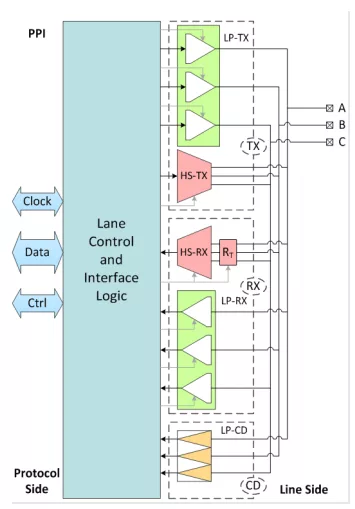
The C-PHY is partitioned into a digital module – CIL (Control and Interface Logic) and a mixed-signal module. The PHY IP is provided as a combination of soft IP views (RTL, and STA Constraints) for the digital module, and hard IP views (GDSII/CDL/LEF/LIB) for the mixed-signal module. This unique offering of both soft and hard IP permits architectural design flexibility and seamless implementation in customer-specific design flow.

The CIL module interfaces with the protocol layer and determines the global operation of the module. The interface between the PHY and the protocol is using the PHY-Protocol Interface (PPI). The mixed-signal module includes high-speed signaling mode for fast-data traffic and low-power signaling mode for control purposes.

During normal operation, a lane switches between low-power and high-speed mode. Bidirectional lanes can also switch communication direction. The change of operating mode or direction requires enabling and disabling of certain electrical functions. These enable and disable events do not cause glitches on the lines that would result in a detection of incorrect signal levels. All mode and direction changes are smooth to always ensure a proper detection of the line signals.

The C-PHY is a complete PHY, silicon-proven at multiple foundries and multiple nodes. It is built to support the MIPI Camera Serial Interface (CSI) and Display Serial Interface (DSI).

Key features

  • Support for MIPI® compliant C-PHY Specification Version 2.0 with backwards compatibility for MIPI C-PHY v1.2 and v1.1
  • Supports up to 3 lanes/trios
  • Supports both high-speed and low-power modes
  • 80 Msps to 4.5 Gsps symbol rate per lane in C-PHY high-speed mode
  • Equivalent to 182.8 Mbps to 10.26 Gbps per lane in C-PHY high-speed mode
  • 10 Mbps data rate in low-power mode
  • Supports CSI-2, DSI, and DSI-2
  • Low power dissipation
  • Loopback testability (BIST) support

Block Diagram

Benefits

  • Comprehensive embedded DFT features for allowing cost-effective high-volume manufacturing tests
  • Support for full-speed internal loopback testability with minimal area overhead for high-volume manufacturing tests in the C-PHY Universal, TX+, and RX+ configurations
  • Support for MIPI C-PHY v2.0 features not available in previous versions of the specifications such as Spread Spectrum Clocking (SSC) and transmit equalization (de-emphasis)
  • Support for new power saving functionality such as HS-TX half swing mode and HS-RX unterminated mode
  • Support for new Alternate LP Mode, suitable for IoT applications with long channels, enabling Fast Bus Turnaround

Specifications

Identity

Part Number
MXL-CPHY
Vendor
Mixel, Inc.
Type
Silicon IP

Standards & Interfaces

MIPI PHY
MIPI C-PHY

Files

Note: some files may require an NDA depending on provider policy.

Provider

HQ: USA

Learn more about MIPI PHY IP core

MIPI M-PHY takes center stage

The curtain is up and the M-PHY specification is taking center stage, positioned to handle the many different roles required for a faster, more reliable, physical interface layer (PHY Layer) on mobile devices.

Dual Mode C-PHY/D-PHY: Enabling Next Generation of VR Displays

For many years, Virtual Reality (VR) and Augmented Reality (AR) were strongly linked to gaming and entertainment applications. Today, the VR/AR and their combined version, Mixed Reality (MR), have their applications extended to other domains like healthcare, military, education, manufacturing, retail, marketing and advertising. What are the challenges for next generation VR displays? What makes the MIPI interfaces the best fit for VR/AR/MR applications?

Demystifying MIPI C-PHY / DPHY Subsystem

The newest member of the MIPI® PHY family, the C-PHY, arrived in October 2014 to a mixture of excitement and apprehension. How would this new C-PHY compare to the MIPI D-PHY and M-PHY®? What would differentiate the C-PHY, and would it be compatible enough with the D-PHY so that both could coexist in a hybrid subsystem? Now, years later, the answers are clear.

Can MIPI and MDDI Co-Exist?

Since MIPI and MDDI standards both target interfaces to cameras and displays on mobile devices, are two separate standards really needed?

Frequently asked questions about MIPI PHY IP

What is MIPI C-PHY?

MIPI C-PHY is a MIPI PHY IP core from Mixel, Inc. listed on Semi IP Hub.

How should engineers evaluate this MIPI PHY?

Engineers should review the overview, key features, supported foundries and nodes, maturity, deliverables, and provider information before shortlisting this MIPI PHY IP.

Can this semiconductor IP be compared with similar products?

Yes. Buyers can compare this product with similar semiconductor IP cores or IP families based on category, provider, process options, and structured technical specifications.

×
Semiconductor IP