MIPI C/D-PHY CSI/DSI TX and RX
The MIPI C/D-PHY + DSI/CSI Controller IP is a versatile solution designed for high-speed data transmission in mobile and multimed…
Overview
The MIPI C/D-PHY + DSI/CSI Controller IP is a versatile solution designed for high-speed data transmission in mobile and multimedia applications. It integrates C-PHY and D-PHY in a single IP core, supporting both MIPI C-PHY 1.1 and D-PHY 2.0 standards. The IP features a compact design with built-in I/O and ESD protection, optimized for robust performance and low power consumption. It enables seamless connectivity with C-PHY and D-PHY based sensors, making it ideal for SoCs in consumer electronics, automotive, and IoT devices.
The Innosilicon C/D Combo PHY supports high-speed and low-speed modes for bidirectional data transfer. It offers both receiver and transceiver solutions, ensuring efficient data transmission in both C-PHY and D-PHY modes. The PHY is designed to coexist on the same IC pins, enabling dual-mode operation with minimal overhead.
The DSI Controller implements the MIPI DSI-2 protocol, enabling high-speed display communication. It packs and distributes pixel data to the C/D-PHY, supporting features like pixel/byte packing, low-level protocol, and lane management. The DSI TX transmits data to display, while the DSI RX reconstructs data streams from display, ensuring error-free communication. This IP is ideal for mobile devices, AR/VR headsets, and automotive displays, offering high performance and low latency.
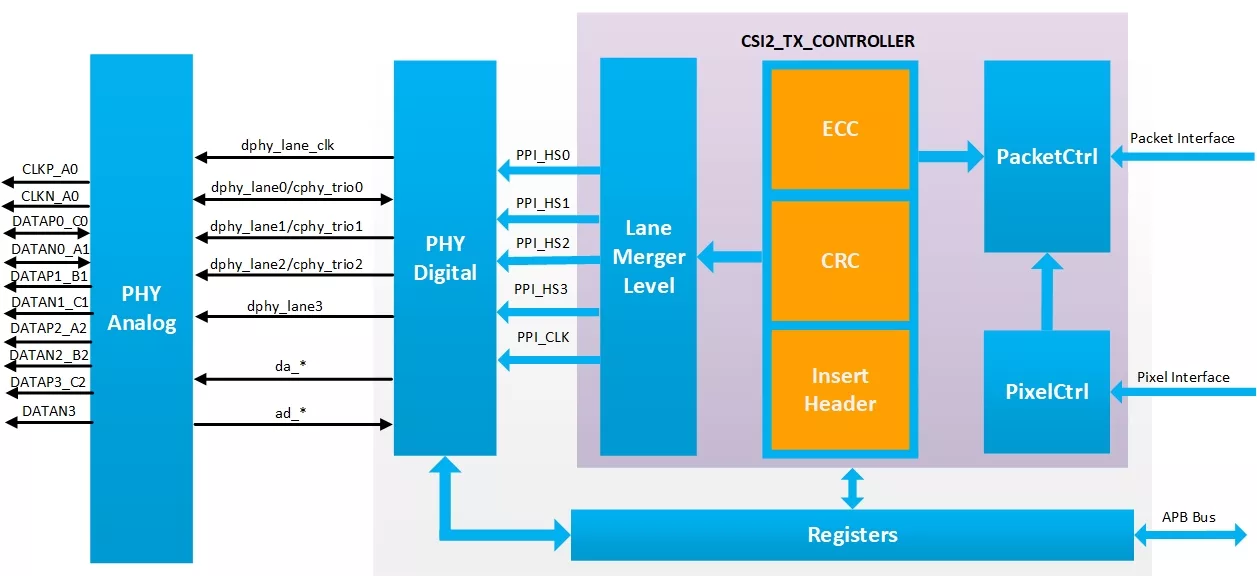
The CSI Controller implements the MIPI CSI-2 protocol, facilitating camera-to-processor communication. It packs pixel data for transmission via the C/D-PHY and reconstructs data streams at the receiver end. The CSI TX/RX supports error detection (ECC/CRC) and lane management, ensuring reliable data transfer. This IP is widely used in smartphones, drones, surveillance cameras, and automotive ADAS systems, providing high-speed, low-power connectivity for image sensors.
Key features
- Compliant with MIPI Alliance Specification for D-PHY V2.0
- Compliant with MIPI Alliance Specification for C-PHY V1.1
- Compliant with MIPI Alliance Specification for DSI-2 V1.0
- Compliant with MIPI Alliance Specification for CSI-2 V2.0
- HS, LP, ULPS modes supported
- 4.5Gbps maximum data transfer rate per lane in D-PHY mode
- 3.5Gsps maximum data transfer rate per trio in C-PHY mode
- Asynchronous transfer in low power mode with a bit rate of 10Mbps in both C-PHY and D-PHY
- Unidirectional and bi-directional modes supported
- Skew-calibration for D-PHY supported
- ECC and CRC insertion supported
- Automatic termination control for HS and LP modes
- Buffers with tunable on-die-termination and advanced equalization
- Supports BIST logic
- Supports combo LVDS/TTL IP
- Supports combined with DSC1.2A for delivery
Block Diagram
Benefits
- Low power consumption
- Fully customizable
- High speed hub use VLPI low latency
- Small area
- Simple integration process
- Available options include
- Test chips and test boards
- FPGA integration support
- Chip level integration
What’s Included?
- Databook and physical implementation guides Netlist (Spice format for LVS)
- Library Exchange Format (LEF)
- Verilog Models
- GDSII to Foundry IP Merge
- Module integration guidelines
- Silicon validation report (when available)
- Evaluation board (when available)
Specifications
Identity
Standards & Interfaces
Files
Note: some files may require an NDA depending on provider policy.
Provider
Learn more about MIPI PHY IP core
MIPI DPHY Solution
Infineon Drives Automotive MCU Performance Higher with Synopsys Interface IP
Cadence First to Demo Complete M-PCIe PHY and Controller Solution at MIPI and PCI-SIG Conferences
Super Edge Medical SoC (SEMC)
D-PHY, M-PHY & C-PHY? First Look at Testing MIPI's Latest PHY
Frequently asked questions about MIPI PHY IP
What is MIPI C/D-PHY CSI/DSI TX and RX?
MIPI C/D-PHY CSI/DSI TX and RX is a MIPI PHY IP core from Innosilicon Technology Ltd listed on Semi IP Hub.
How should engineers evaluate this MIPI PHY?
Engineers should review the overview, key features, supported foundries and nodes, maturity, deliverables, and provider information before shortlisting this MIPI PHY IP.
Can this semiconductor IP be compared with similar products?
Yes. Buyers can compare this product with similar semiconductor IP cores or IP families based on category, provider, process options, and structured technical specifications.