Vendor: Altera Category: Video Transport

LVDS Tunneling Protocol and Interface (LTPI) IP

LVDS Tunneling Protocol and Interface (LTPI) is a soft IP introduced in the DC-SCM 2.0 Specification to facilitate the tunneling …

Overview

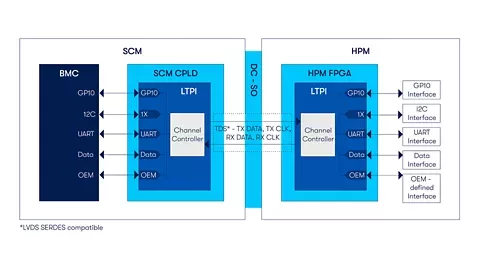
LVDS Tunneling Protocol and Interface (LTPI) is a soft IP introduced in the DC-SCM 2.0 Specification to facilitate the tunneling of low-speed signals between the host platform module (HPM) and secure control module (SCM) through the low-voltage differential signaling (LVDS) interfaces.

Next-Gen Protocol for DC-SCM 2.0

The LTPI interface is designed for tunneling various low-speed signals between the Host Processor Module (HPM) and the Secure Control Module (SCM). It can be implemented with two FPGA or CPLD devices for configurations with typical BMC devices.

Both HPM and SCM work together to manage and secure communication within a system by tunneling control signals over the LVDS interface within the system. 
Key features

  • Compliant with OCP DC-SCM 2.0 LTPI 1.0 specifications.
  • Supports all speed-grade configurations for the Agilex™ 5 devices.
  • Supports up to five channel aggregation and disaggregation.
  • Supports GPIO, I2C, UART, OEM, and data channel aggregations. 
  • Supports link training for reliable link operation.
  • Supports up to 500 Mbps data rate for all speed-grade configurations in Agilex™ 5 devices.

Block Diagram

Applications

  • Data Centers: LTPI communicates between Host Processor Modules (HPM) and Secure Control Modules (SCM), enabling efficient control signal management and real-time data transfer.
  • Embedded Systems: Ideal for embedded systems requiring efficient control plane expansion and low-latency signal transmission.
  • High-Speed Video Streaming: LTPI can be used for high-speed video streaming applications, demonstrating its adaptability beyond traditional use cases.
  • FPGA-Based Designs: LTPI is well-suited for FPGA and CPLD implementations, providing scalable, low-latency transport mechanisms for various control signals

Specifications

Identity

Part Number
LVDS Tunneling Protocol and Interface (LTPI) IP
Vendor
Altera
Type
Silicon IP

Files

Note: some files may require an NDA depending on provider policy.

Provider

HQ: USA

Learn more about Video Transport IP core

Debugging FPGA-based video systems: Part 2

In Part 2 of this series from Digital Video Processing For Engineers, Andrew Draper describes some of the strategies for debugging an FPGA-based video system to be sure it reliably delivers the necessary video streams in real time. Part 2: Clocked and flow controlled video streams.

Debugging FPGA-based video systems: Part 1

Andrew Draper describes some of the strategies for debugging an FPGA-based video system to be sure it reliably delivers video streams in real time. Part 1: Timing analysis and debugging.

Scalable architectures for high-bandwidth Ethernet line cards

As more consumers receive streaming video in various formats over the Internet, demand for bandwidth continues to increase. However, consumers watching streaming movies via their Xbox or Wii, or viewing YouTube on their computers, are not paying more for the additional gigabits they download each month watching these video feeds. This is one of many factors fueling the demand for higher bandwidth while yielding lower price per gigabit of bandwidth.

The Need for Variable Precision DSP Architecture

FPGAs with variable-precision DSP block architecture are the only programmable devices that can efficiently support many different precision levels including floating-point implementations. This DSP architecture enables the next-generation of high-precision and high-performance signal processing applications.

Frequently asked questions about Video Transport IP cores

What is LVDS Tunneling Protocol and Interface (LTPI) IP?

LVDS Tunneling Protocol and Interface (LTPI) IP is a Video Transport IP core from Altera listed on Semi IP Hub.

How should engineers evaluate this Video Transport?

Engineers should review the overview, key features, supported foundries and nodes, maturity, deliverables, and provider information before shortlisting this Video Transport IP.

Can this semiconductor IP be compared with similar products?

Yes. Buyers can compare this product with similar semiconductor IP cores or IP families based on category, provider, process options, and structured technical specifications.

×
Semiconductor IP