Overview
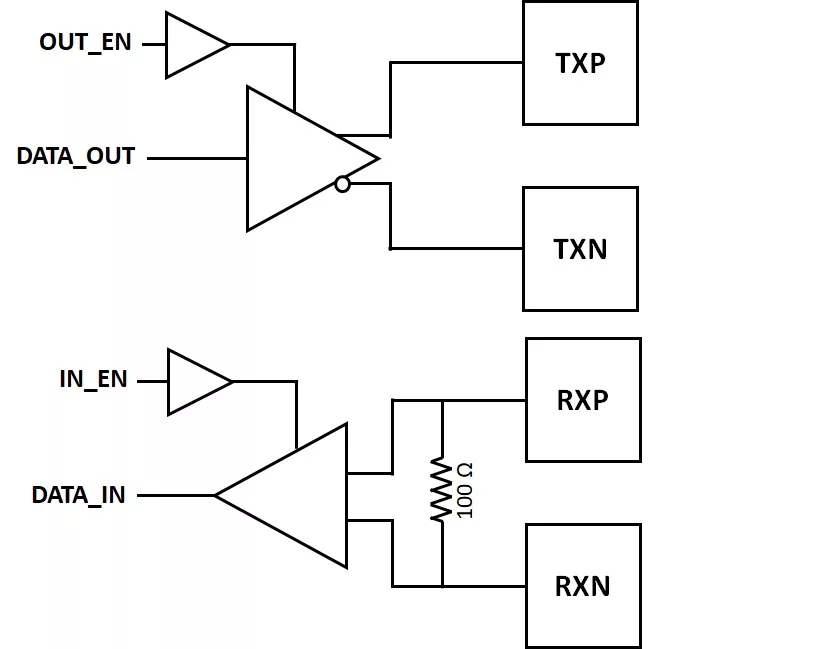
Certus provides full LVDS RX & TX IOs in GlobalFoundries and other foundry technologies. The Certus LVDS solutions are ANSI/TIA/EIA-644-A compliant and are capable of data rates of up to 1.5Mbps. Unique to the Certus LVDS solution is that it is self-biased with no external reference blocks required. Our LVDS cell configurations also allow for flexible supply pad arrangements and dense IO placement without compromising signal integrity.
Built into our IO libraries, and also offered as a separate service, is our strong ESD expertise. Certus was founded by ESD engineers and our results speak for themselves. Not only do we address standard ESD such as HBM and CDM, but we can also provide on-chip solutions for standards such as IEC-61000-4-2, system-level ESD and Cable Discharge Events (CDE).
Certus also offers RGMII, SD, I2C, SMBUS, DDC, Analog/RF, HV and other IO variants across most major foundries and technology nodes. We are particularly suited at providing customized options in a cost-efficient framework. Please contact us for supplementary physical or electrical features to suit your needs.
Learn more about Single-Protocol PHY IP core
This blog will focus on what happens during the CDM pulse itself, and will show how the pulse properties change as a function of DUT to Field Plate capacitance.
As semiconductor designs continue to diversify, many successful products are not chasing the most advanced process nodes. Instead, they prioritize power efficiency, reliability, and long-term availability.
Integrated circuits are commonly tested for ESD robustness with 2 tests, Human Body Model (HBM) and Charged Device Model (CDM). Most engineers quickly grasp the procedure for HBM, but the CDM test is often poorly understood. This is unfortunate, because a large fraction of the ESD failures experienced in modern board assembly operations are CDM type failures. This article will describe the events which occur during a CDM test conducted using the widely accepted field induced CDM (FCDM) test.
Certus Semiconductor’s I/O libraries for TSMC’s 22nm ultra-low leakage (22ULL) and 22nm ultra-low power (22ULP) technologies offer robust, high-performance solutions tailored to a wide range of SoC designs — from ultra-low power IoT nodes to demanding consumer and automotive systems. Whether you need low leakage, high drive strength, or analog compatibility, our production-proven IP covers it all.
As a member of the TSMC IP Alliance, Certus delivers production-proven IP that ensures seamless integration with TSMC process nodes, ranging from 180nm to 12nm.
In today’s data-driven world, high-speed, low-power communication is essential. Certus Semiconductor’s LVDS Transceiver delivers exactly that—optimized for GlobalFoundries’ 12nm CMOS process, it provides reliable, high-performance Low-Voltage Differential Signaling (LVDS) for next-generation designs.