Overview
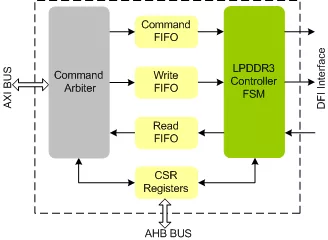
LPDDR3 interface provides full support for the LPDDR3 interface, compatible with JESD209-3,JESD209-3B and JESD209-3C specification and DFI-version 3.1 or higher specification Compliant. Through its LPDDR3 compatibility, it provides a simple interface to a wide range of low-cost devices. LPDDR3 IIP is proven in FPGA environment. The host interface of the LPDDR3 can be simple interface or can be AMBA AHB, AMBA AHB-Lite, AMBA APB, AMBA AXI, AMBA AXI-Lite, Tilelink, OCP, VCI, Avalon, PLB, Wishbone or Custom protocol.
LPDDR3 Controller IIP is supported natively in Verilog and VHDL
Learn more about LPDDR IP core
This collaboration combines SmartDV’s production-proven IP with Mirabilis Design’s VisualSim® system-level modeling platform to provide customers with fully validated architectural models that reflect real implementation behavior.
Comprehensive support for both MIPI SoundWire I3S 1.0 and draft 1.1 specifications delivers flexible, standards-aligned integration for advanced audio, voice, and control subsystems
As the Compute Express Link® (CXL®) specification rapidly evolves, so too must the tools and infrastructure used to verify designs built around it. Maintaining verification IP (VIP) that keeps pace with new specification revisions is no small task, particularly when dealing with major version shifts like the transition from CXL 2.0 to 3.0.
SmartDV supports all three profiles of each technology: Baseline, Main, and High for H.264, and Main, Main 10, and Main Still Picture for H.265, enabling seamless integration and unparalleled flexibility for developers across diverse applications.
To meet RANiX’s unique design goals, SmartDV will customize the IP to go beyond the standard SDIO functionality—thereby empowering RANiX to differentiate from their competitors. SmartDV will also provide RANiX with the requisite support and documentation to achieve ASIL certification for ISO 26262.
SmartDV™ Technologies, provider of flexible, customizable semiconductor design IP (intellectual property) and verification solutions, has expanded engineering operations beyond its headquarters in Bengaluru with the opening of a new office space in Coimbatore, Tamil Nadu, India.