Overview
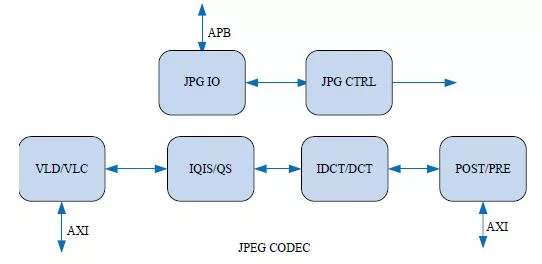
JPEG codec is designed to provide high performance solution for jpeg decoder and encoder. JPEG codec is fully compliant with the baseline and extended sequential DCT mode of ISO/IEC 10918-1 JPEG standard. It also part compliant with ISO/IEC 18477 for supporting 10/12bit sample size.
JPEG codec is in-built Variable Length Decode/Encode (VLD/VLC), Inverse Scan/Scan (IS/S), Inverse Quantization/ Quantization (IQ/Q), Inverse Discrete Cosine Transform/ Discrete Cosine Transform (IDCT/DCT), Scaling down hardware engine. JPEG Engine architecture with based on MCU layer.
On the fly pre and post image processing can support scaling , rotation and color space conversion. 32bit APB/128bit AXI standard interface make the integration is more convenient and efficient.
Learn more about Image Conversion IP core
T2M-IP, the global leader in semiconductor IP cores and technology expertise, is proud to announce the immediate availability of its partner's VESA-compliant DisplayPort v1.4 Rx PHY and Controller IP Cores.
T2M announces the availability of its partner’s Bluetooth V6.0 RF Transceiver IP Core in 22nm ULL and 40nm ULP.
Incorporating BroadR-Reach™ technology for Automotive Excellence, this PHY delivers exceptional performance for automotive and industrial applications, providing a superior alternative to traditional BaseT1 solutions.
Designed to meet the evolving needs of next-generation automotive and industrial applications, the CAN XL Controller IP offers superior performance and flexibility while maintaining backward compatibility with previous CAN standards.
T2MIP, a leading provider of semiconductor IP cores, proudly announces the immediate availability of their partner's H.264 and H.265 HEVC Codec IP cores.
T2M-IP is excited to announce that its state-of-the-art USB 3.0 IP, developed in the 22nm ULP (Ultra Low Power) and ULL (Ultra Low Leakage) process technologies, has been successfully licensed to over 10 customers worldwide in the past two years.