Overview
The I2C (Inter - Integrated Circuit) protocol is a widely used serial communication protocol for transferring data between electronic devices. It was developed by Philips in the 1980s and is now owned by NXP Semiconductors. I2C uses two bidirectional data lines called SDA (Serial Data) and SCL (Serial Clock) for communication between devices. It allows multiple devices to be connected to the same bus, and each device can be identified by a unique address. The protocol supports data transfer rates ranging from a few kilobits per second to several hundred kilobits per second.
I2C is commonly used in embedded systems, especially for connecting sensors, LCD displays, and other peripherals. It is also used in communication between microcontrollers and various ICs such as EEPROMs, ADCs, DACs, and more.
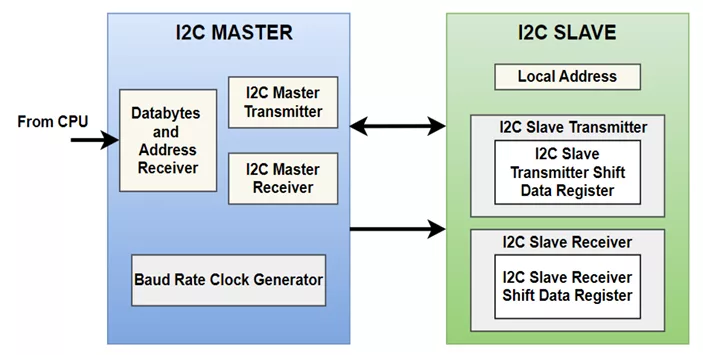
The protocol supports two modes of operation : master and slave. In the master mode, the master device initiates the communication and controls the SCL line. In the slave mode, the slave device responds to the master's requests. Overall, I2C is a reliable, efficient, and widely adopted communication protocol that facilitates seamless data transfer between different electronic devices.
Product Specifications :
- RTL Design (System Verilog).
- Test Bench (Universal Verification Methodology (UVM))
- Clock Frequency : IP core baudrates are adjustable (100kb/ps, 400kb/ps, 1Mb/ps and 3.2Mb/ps)
- Compatible with 8 bit Micro - controller.
Product Options :
- Adaptations : Generic 8 Bit 8051 Microcontroller Interface available.
- PCI / AXI possible.
- Add - ons : Verification IP - UVM VIP.
I2C Protocol Packet Format :
- Start Bit : a single condition that signals the start of a transmission.
- Slave Address : the address of the device being addressed in the transmission, either 7 bits or 10 bits in length depending on the configuration.
- R/W Bit : a single bit that indicates whether the transaction is a read or write operation.
- Address Acknowledge : a single bit that signals whether the receiver has acknowledged the Address.
- Data Byte : one or more bytes of data being transmitted between devices.
- Data Acknowledge : a single bit that signals whether the receiver has acknowledged the Data.
- Stop Bit : a single bit that signals the end of a transmission.
Learn more about I2C / I3C IP core
The I2C (Inter-Integrated Circuit) Bus invented in 1980 by Philips Semiconductors (NXP Semiconductors today) was a massive step forward in simplifying communications in embedded systems. It is a simple two-wire interface for synchronous, multi-master/multi-slave, single ended serial communication. Fast forward 45 years to today and it is still widely used for attaching low speed peripheral Integrated Circuits (ICs), processors and microcontrollers. But silicon today has changed...
Based on the MIPI I3C, CHIPS Alliance, part of Linux Foundation, introduced an open source I3C Core. The Core is already used in the likewise CHIPS-hosted Caliptra Root-of-Trust project and the SoC reference design Guineveer based on the VeeR EL2 RISC-V core.
Early in my career selling chips for Motorola Semiconductor, the ability to spin derivative microcontroller chips for a customer’s specific requirement was relatively straightforward. If the volume looked reasonable, we would tape-out a new chip with a few added features because mask costs and wafers were relatively inexpensive at the larger process nodes. The customer won by getting an MCU tailored to their specific need, and Motorola won by gaining a more committed customer plus another SKU that could be sold to other customers – boosting ROI. With the migration to higher cost FinFET nodes, those times are long gone as the economics no longer work.
Sharmion Kerley, MIPI Director of Marketing and Membership
Imagine a camera subsystem that responds in microseconds, consumes less power, and offers a more straightforward route to time-to-market. For SoC architects and IP integration teams, that vision is increasingly possible with MIPI Camera Control Interface (CCI) over I3C.