HKDF/HMAC/SHA-256/SHA-512, SHA-256 IP Core with Extended Functionalities
XIP3327Cis a versatile Intellectual Property (IP) core designed for SHA-256 and SHA-512 cryptographic hash functions with extende…
Overview
XIP3327Cis a versatile Intellectual Property (IP) core designed for SHA-256 and SHA-512 cryptographic hash functions with extended support for HMAC message authentication code and HKDF key derivation function that are based on using SHA-256. SHA-256 and SHA-512 are among the most commonly used hash functions and are used in numerous cryptographic applications. XIP3327C is optimized for low FPGA resource requirements.
XIP3327C has been designed for easy integration with FPGA- and ASIC-based designs in a vendor-agnostic design methodology, and the functionality of XIP3327C does not rely on any FPGA manufacturer-specific features.
XIP3327C has also been successfully validated in the CAVP (Cryptographic Algorithm Validation Program) by NIST (National Institute for Standards and Technology).
Key features
- Versatility: XIP3327C supports the widely used cryptographic hash functions SHA-256 and SHA-512. It also has native support for commonly used message authentication code (HMAC) based on SHA-256 and key derivation function (HKDF) based on HMAC-SHA-256. This allows using XIP3327C for multiple cryptographic functions —for example, TLS 1.3 [4] —more easily and efficiently than an IP core that supports only SHA-256 or SHA-512.
- Constant Latency: The execution time of XIP3327C is independent of the message and key values (apart from message length), and consequently provides protection against timing based side-channel attacks.
- Compact Size: XIP3327C has compact size (for example, 1199 LUTs and, 2/1 RAMB36/18 in Xilinx® Zynq-7000® family) permitting integration into resource constrained FPGA designs.
- Standard Compliance: XIP3327C is compliant with NIST FIPS 180-4 Secure Hash Standard (SHS) [2], FIPS 198-1 The Keyed-Hash Message Authentication Code (HMAC) [1], and RFC 5869 HMAC-based Extract-and-Expand Key Derivation Function (HKDF) [3]. Consequently, XIP3327C can be used in multiple cryptographic applications.
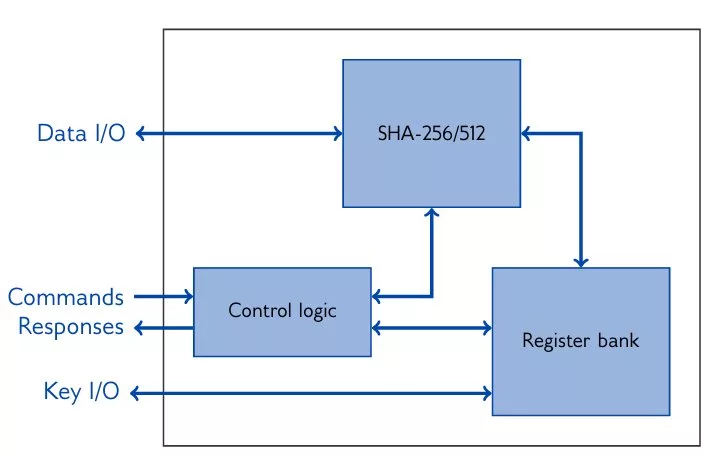
Block Diagram
Benefits
- Fully digital design
- Portable to any ASIC or FPGA technology
- Fully standard compliant
- Easy to integrate
- Several bus interfaces available
- IP core designed in-house at Xiphera
- Technical support by the original designers and cryptographic experts
- CAVP validated
Applications
- XIP3327C supports five main functionalities:
- SHA-256: Computes a SHA-256 hash for an input message.
- SHA-512: Computes a SHA-512 hash for an input message.
- HMAC: Computes an HMAC-SHA-256 authentication tag for an input message using an authentication key.
- HKDF-extract: Computes the HKDF-extract function that calculates a pseudorandom key from initial key material.
- HKDF-expand: Computes the HKDF-expand function that expands the pseudorandom key to several additional pseudorandom keys of desired lengths for specific cryptographic algorithms.
What’s Included?
- Please contact sales@xiphera.com for pricing and your preferred delivery method. XIP3327C can be shipped in a number of formats, including netlist, source code, or encrypted source code.
- Additionally, synthesis scripts, a comprehensive testbench, and a detailed datasheet including an integration guide are included.
Specifications
Identity
Security
Files
Note: some files may require an NDA depending on provider policy.
Provider
Learn more about Hash / MAC IP core
Embedded Security explained: Cryptographic Hash Functions
Embracing a More Secure Era with TLS 1.3
Standardized PUF-based Solution for Device eID
Implementing Ultra Low Latency Data Center Services with Programmable Logic
Security in vehicular systems
Frequently asked questions about Hash / MAC IP cores
What is HKDF/HMAC/SHA-256/SHA-512, SHA-256 IP Core with Extended Functionalities?
HKDF/HMAC/SHA-256/SHA-512, SHA-256 IP Core with Extended Functionalities is a Hash / MAC IP core from Xiphera Ltd listed on Semi IP Hub.
How should engineers evaluate this Hash / MAC?
Engineers should review the overview, key features, supported foundries and nodes, maturity, deliverables, and provider information before shortlisting this Hash / MAC IP.
Can this semiconductor IP be compared with similar products?
Yes. Buyers can compare this product with similar semiconductor IP cores or IP families based on category, provider, process options, and structured technical specifications.