Overview
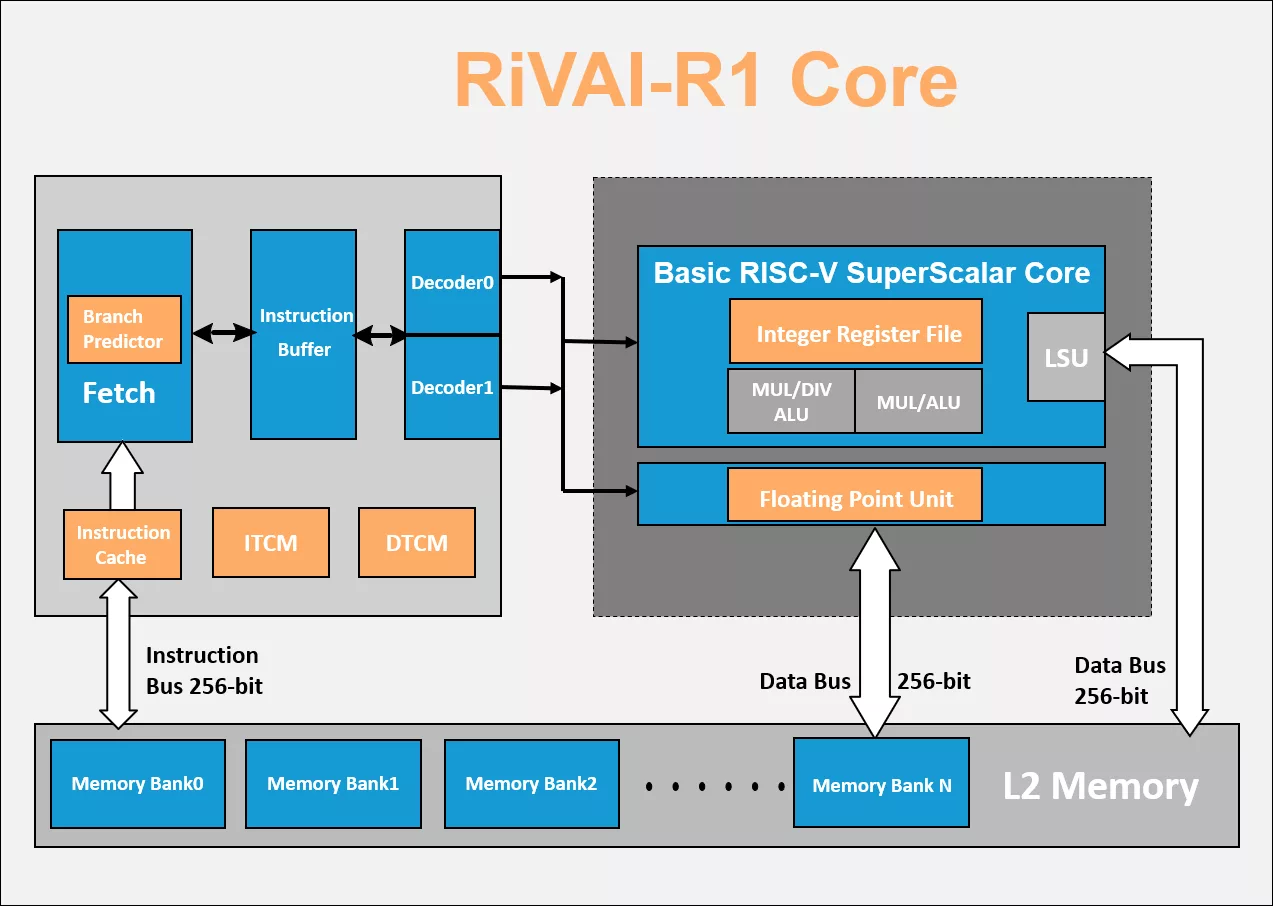
RiVAI-R1 is a dual-issue, Out-of-Order execution, 7-stage pipeline, 32-bit RISC-V CPU core IP that supports the RV32IMFAC instruction sets, as well as partial P extension. It is a real-time high-performance CPU IP, which can boost the performance of voice, audio, video, image and AI processing. Its “F” extensions support IEEE 754-compliant single precision floating point instructions, as well. Including register renaming, the memory access width is 256 bits. This greatly enhances memory bandwidth and reduces memory latencies for applications with intensive memory accesses. In addition, RiVAI-R1 features an advanced low-power, dynamic branch-prediction mechanism for efficient branch execution, instruction and data caches, local memories, and ECC error protection. It also includes a vectored and preemptive interrupt controller to serve diversified system events, an AHB bus, rich power management, and JTAG debug and trace interface for software development support.
Learn more about CPU IP core
This article shares our experience using Google’s FlatBuffers library as a memory subsystem stress test on the Andes AX46MPV RISC-V core.
For the first time in our more than 35-year history, Arm is delivering its own silicon products – extending the Arm Neoverse platform beyond IP and Arm Compute Subsystems (CSS) to give customers greater choice in how they deploy Arm compute – from building custom silicon to integrating platform-level solutions or deploying Arm-designed processors.
The ChiPy DSL is Quadric's Python framework for building complete on-chip pipelines. Using YOLOX-M as a case study, we show how backbone inference, box decoding, and NMS run entirely on the Chimera GPNPU — no host CPU intervention, no DDR round-trips, just Python compiled to silicon.
As part of the new Arm Lumex compute subsystem (CSS) platform, the Arm C1 CPU cluster – the first built on the Armv9.3 architecture – is the next evolution of our highest performing CPU cluster for consumer devices, designed to unleash the full potential of on-device AI and elevate the user experience.
Hardware fuzzing has recently gained momentum with many discovered bugs in open-source RISC-V CPU designs. Comparing the effectiveness of different hardware fuzzers, however, remains a challenge: each fuzzer optimizes for a different metric and is demonstrated on different CPU designs.
Unlock ultra-efficient performance, advanced AI processing, and robust security with the Cortex-A320—designed to power the future of IoT and edge AI innovation.