Overview
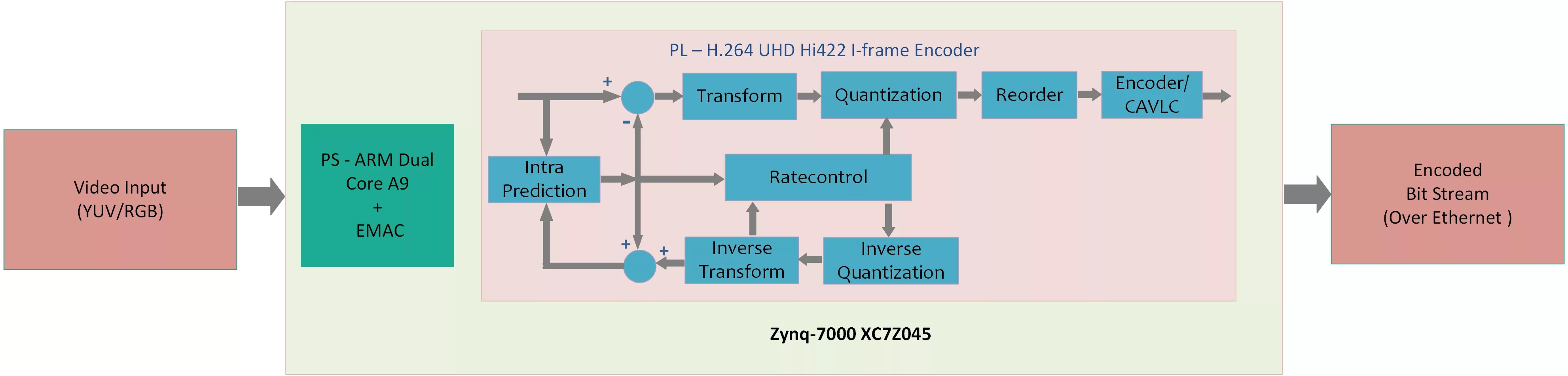
The AL-H264E-4KI422-HW is a hardware-based, feature rich, low latency, high video quality H.264 (AVC) UHD Hi422 Intra encoder IP core. The AL-H264E-4KI422-HW encoder pairs up with the Atria Logic AL-H264D-4KI422-HW low latency decoder for low latency end-to-end links.
The encoder is targeted for medical imaging, broadcast, enterprise/CE and industrial applications. Medical imaging applications include endoscopy, micro surgery and remote assisted surgery and diagnostics. Broadcast applications include video recorders for news and event coverage, film sets and production studios, as well as real-time monitoring of video shoots. Enterprise/CE applications include HDBaseT video transmission over CAT5/6 Ethernet cabling to computer monitors and UHD TV displays. Industrial applications include monitoring of manufacturing plants, and remote manipulation of mobile or fixed light or heavy machinery.
The encoder supports the H.264 Hi422 (High-422) profile at Level 5.1 (3840x2160p30) for Intra-only coding. Support for 10-bit video content means that there is no degradation of grayscale or color gradients in terms of banding. Support for YUV 4:2:2 video content means that there is better color separation, especially noticeable for red colors, which provides much sharper image details. These video quality aspects are especially important in case of medical imaging applications.
Support for Intra-only encoding allows the encoder to encode uncompressed video at frame latencies. A macroblock-line level pipelined architecture brings the latency further down to sub-frame level, at about 0.3msec. When connected to the Atria Logic AL-H264D-4KI422-HW low latency decoder via an IP network, the glass-to-glass latency is about 0.6msec, not taking into account any transmission latency, and otherwise 2 frames with transmission in case of an IP network. Such low latency is important for any closed-loop man-machine application as mentioned here above.
The encoder is implemented in a single Xilinx Zynq-7000 XC7Z045 all programmable SoC. The efficient implementation only takes up 63% of the programmable logic and DSP resources and 36% of the available RAM, leaving ample room for implementation of any other required circuitry. Integration of a Gb Ethernet MAC provides streaming over IP support.
Learn more about Video Processing IP core
Numerous industries in broadcast, cable, videoconferencing and consumer electronics space are using H.264 as the video codec of choice for their products and services. The H.264/AVC video coding standard achieves a significant improvement in coding efficiency with increased computational complexity relative to former standards.
This article describes the use of a low-cost, low-density Zynq FPGA in creating a computational platform for implementing infotainment systems for passenger vehicles, such as cars, buses, trains, airplanes and ships. Other applications for this kind of platform include digital signage and information displays in private and public venues such as hotels, hospitals, gas pumps, or kiosks as well as digital picture frames for consumer markets.
With ever increasing need for very high operating frequency of graphics (GPU) or general purpose (CPU) processors, the limited memory bandwidth forms a bottleneck to extract maximum performance out of a system. To add to this, low power consumption, form factor of the memory devices also play significant roles in optimal and efficient solutions.
High Bandwidth Memory (HBM) is a high-performance 3D-stacked DRAM. It is a technology which stacks up DRAM chips (memory die) vertically on a high speed logic layer which are connected by vertical interconnect technology called TSV (through silicon via) which reduces the connectivity impedance and thereby total power consumption.