Overview
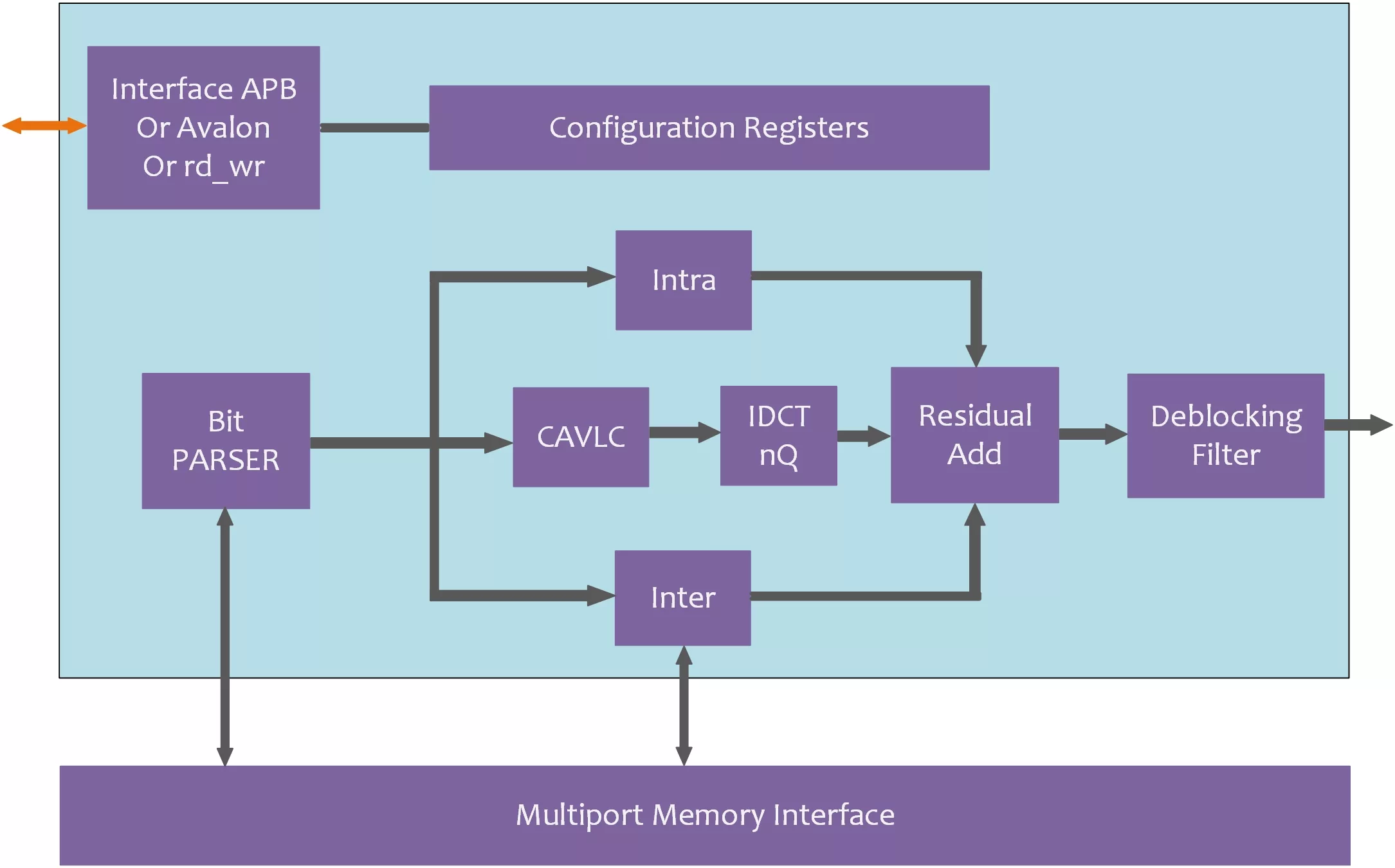
The Atria Logic AL-H264D-HW is a hardware-based, low power, low latency, feature-rich, H.264 (AVC) Baseline Profile video decoder IP core, targeted for mobile and non-mobile, low power devices in industrial, medical and CE applications. Industrial applications include remote monitoring of manufacturing plants, remote control of UAVs, and digital signage for advertising and information displays in hotels, ATMs, gas pumps, kiosks, etc. Medical applications include endoscopic, assisted surgery and remote diagnostics applications, CE applications include in-flight and automotive infotainment systems, netbooks, tablets and smartphones.
The decoder supports Baseline Profile I+P decoding up to Level 4.1 (1080p30), as well as error resiliency/robustness with Arbitrary Slice Ordering (ASO), Flexible Macroblock Ordering (FMO) and skipped macroblock support when receiving video data packets over unpredictable networks.
The decoder is fully H.264 standards compliant, with support for all 4x4 and 16x16 luma and all chroma modes, up to 16 motion vectors (i.e., all permitted block sizes) per macroblock, cross-frame boundary motion vectors, 1/2 and 1/4 pel motion compensation and a large horizontal and vertical motion vector range of +/-2048 and +/- 512, respectively. An in-loop deblocking filter is also included for enhanced video quality.
Configuration and control support of the decoder is supported via a register set which is accessible over the AMBA/AVALON bus. The RTL implementation supports a hardwired, micro-code free mode of implementation, as well as an ARM embedded processor assisted hardware-software partitioned mode of implementation.
The decoder design is based on a synchronous, positive-edge clocking scheme for easy targeting to ASIC or FPGA implementations. A clock-gated, multi-clock domain design supports very low power operation modes. For instance, 30fps CIF decode using only a 12MHz clock source. The design is easily scalable to decode multiple streams simultaneously.
Learn more about Video Processing IP core
Numerous industries in broadcast, cable, videoconferencing and consumer electronics space are using H.264 as the video codec of choice for their products and services. The H.264/AVC video coding standard achieves a significant improvement in coding efficiency with increased computational complexity relative to former standards.
This article describes the use of a low-cost, low-density Zynq FPGA in creating a computational platform for implementing infotainment systems for passenger vehicles, such as cars, buses, trains, airplanes and ships. Other applications for this kind of platform include digital signage and information displays in private and public venues such as hotels, hospitals, gas pumps, or kiosks as well as digital picture frames for consumer markets.
With ever increasing need for very high operating frequency of graphics (GPU) or general purpose (CPU) processors, the limited memory bandwidth forms a bottleneck to extract maximum performance out of a system. To add to this, low power consumption, form factor of the memory devices also play significant roles in optimal and efficient solutions.
High Bandwidth Memory (HBM) is a high-performance 3D-stacked DRAM. It is a technology which stacks up DRAM chips (memory die) vertically on a high speed logic layer which are connected by vertical interconnect technology called TSV (through silicon via) which reduces the connectivity impedance and thereby total power consumption.