GDDR7 Synthesizable Transactor
GDDR7 Synthesizable Transactor provides a smart way to verify the GDDR7 component of a SOC or a ASIC in Emulator or FPGA platform.
Overview
GDDR7 Synthesizable Transactor provides a smart way to verify the GDDR7 component of a SOC or a ASIC in Emulator or FPGA platform. The SmartDV's GDDR7 Synthesizable Transactor is fully compliant with standard GDDR7 Specification and provides the following features.
Key features
- Supports GDDR7 memory devices from all leading vendors.
- Supports 100% of GDDR7 protocol draft JEDEC specification.
- Supports all the GDDR7 commands as per the specs.
- Supports 4 separate independent channels with point-to-point interface for data, address and command.
- Supports command parity
- Supports Double Data Rate (DDR).
- Supports Pseudo channel mode operation.
- Supports 16 - 64 Gbit densities
- Supports X8 mode.
- Supports RDQS mode.
- Supports DQ preamble.
- Supports Bank group features.
- Supports Programmable Read/Write latency.
- Supports Bank grouping and 16 internal banks per channel.
- Supports Data bus inversion (DBI) & Command Address bus inversion (CABI).
- Supports Read/Write data transmission integrity secured by cyclic redundancy check.
- Supports ECC.
- Supports Input/output PLL/DLL on/off mode.
- Supports Read/Write EDC on/off mode.
- Supports Programmable EDC hold pattern for CDR.
- Supports Programmable CRC Read/Write latency.
- Supports Low Power modes.
- Supports Auto refresh & self-refresh modes.
- Supports On-die termination operation.
- Supports Command Address, WCK2CK, Read, and Write Training mode’s.
- Supports IEEE.1149.1 boundary scan operation.
- Checks for following
- Check-points include power on, Initialization and power off rules,
- State based rules, Active Command rules,
- Read/Write Command rules etc.
- All timing violations.
- Supports callbacks for user to get command data on bus.
- Supports all mode registers programming.
- Supports for power down features.
- Quickly validates the implementation of the GDDR7 protocol JEDEC draft specification.
- Bus-accurate timing for min, max and typical values.
- Constantly monitors GDDR7 behavior during simulation.
- Protocol checker fully compliant with GDDR7 JEDEC draft specification.
- Built in functional coverage analysis.
- Supports Callbacks, so that user can access the data observed by monitor.
- Notifies the test bench of significant events such as transactions, warnings, timing and protocol violations
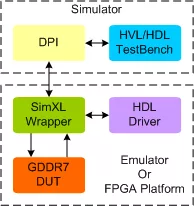
Block Diagram
Benefits
- Compatible with testbench writing using SmartDV's VIP
- All UVM sequences/testcases written with VIP can be reused
- Runs in every major emulators environment
- Runs in custom FPGA platforms
What’s Included?
- Synthesizable transactors
- Complete regression suite containing all the GDDR7 testcases
- Examples showing how to connect various components, and usage of Synthesizable Transactor
- Detailed documentation of all DPI, class, task and function's used in verification env
- Documentation contains User's Guide and Release notes
Specifications
Identity
Files
Note: some files may require an NDA depending on provider policy.
Provider
Learn more about GDDR IP core
SPAD: Specialized Prefill and Decode Hardware for Disaggregated LLM Inference
High Bandwidth Memory Evolution from First Generation HBM to the Latest HBM4
Designing the AI Factories: Unlocking Innovation with Intelligent IP
Breaking the Memory Bandwidth Boundary. GDDR7 IP Design Challenges & Solutions
The Growing Importance of AI Inference and the Implications for Memory Technology
Frequently asked questions about GDDR Interface IP
What is GDDR7 Synthesizable Transactor?
GDDR7 Synthesizable Transactor is a GDDR IP core from SmartDV Technologies listed on Semi IP Hub.
How should engineers evaluate this GDDR?
Engineers should review the overview, key features, supported foundries and nodes, maturity, deliverables, and provider information before shortlisting this GDDR IP.
Can this semiconductor IP be compared with similar products?
Yes. Buyers can compare this product with similar semiconductor IP cores or IP families based on category, provider, process options, and structured technical specifications.