GDDR2 Controller IIP
GDDR2 interface provides full support for the GDDR2 interface, compatible with GDDR2 specification and DFI-version 4.0 or 5.0 Spe…
Overview
GDDR2 interface provides full support for the GDDR2 interface, compatible with GDDR2 specification and DFI-version 4.0 or 5.0 Specification Compliant. Through its GDDR2 compatibility, it provides a simple interface to a wide range of low-cost devices. GDDR2 IIP is proven in FPGA environment. The host interface of the GDDR2 can be simple interface or can be AMBA AHB, AMBA AHB-Lite, AMBA APB, AMBA AXI, AMBA AXI-Lite, Tilelink, OCP, VCI, Avalon, PLB, Wishbone or Custom protocol.
GDDR2 Controller IIP is supported natively in Verilog and VHDL
Key features
- Supports GDDR2 protocol standard GDDR2 Specification.
- Compliant with DFI-version 4.0 or 5.0 Specification.
- Supports all the GDDR2 commands as per the specs.
- Supports up to 16 AXI ports with data width upto 512 bits.
- Supports controllable outstanding transactions for AXI write and read channels
- Supports in port arbitration and multi port arbitration.
- Supports user programmable page policy.
- Closed page policy
- Open page policy
- Supports Error Checking and correction (ECC).
- Supports retry on ECC error, with retry limit user controllable.
- Supports high clock speeds in ASIC and FPGA.
- Supports low latency for write and read path.
- Supports reordering of transactions for higher performance.
- Supports for programmable clock frequency of operation.
- Supports for all types of timing and protocol violation detection.
- Supports for All Mode registers programming.
- Supports for 8 bank operation.
- Supports for Programmable Burst length:4,8.
- Supports for Programmable read latency and write latency.
- Supports for Programmable sequential/interleave burst mode.
- Supports for Bidirectional differential data strobe.
- Supports for Write data mask function.
- Supports for On-die termination (ODT).
- Supports for input clock and frequency change.
- Fully synthesizable
- Static synchronous design.
- Positive edge clocking and no internal tri-states.
- Scan test ready
- Simple interface allows easy connection to microprocessor/microcontroller devices
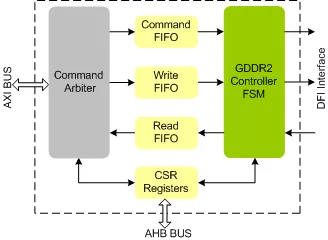
Block Diagram
Benefits
- Single site license option is provided to companies designing in a single site.
- Multi sites license option is provided to companies designing in multiple sites.
- Single Design license allows implementation of the IP Core in a single FPGA bitstream and ASIC.
- Unlimited Designs, license allows implementation of the IP Core in unlimited number of FPGA bitstreams and ASIC designs.
What’s Included?
- The GDDR2 interface is available in Source and netlist products.
- The Source product is delivered in verilog. If needed VHDL, SystemC code can also be provided.
- Easy to use Verilog Test Environment with Verilog Testcases.
- Lint, CDC, Synthesis, Simulation Scripts with waiver files.
- IP-XACT RDL generated address map.
- Firmware code and Linux driver package.
- Documentation contains User's Guide and Release notes.
Specifications
Identity
Files
Note: some files may require an NDA depending on provider policy.
Provider
Learn more about GDDR IP core
SPAD: Specialized Prefill and Decode Hardware for Disaggregated LLM Inference
High Bandwidth Memory Evolution from First Generation HBM to the Latest HBM4
Designing the AI Factories: Unlocking Innovation with Intelligent IP
Breaking the Memory Bandwidth Boundary. GDDR7 IP Design Challenges & Solutions
The Growing Importance of AI Inference and the Implications for Memory Technology
Frequently asked questions about GDDR Interface IP
What is GDDR2 Controller IIP?
GDDR2 Controller IIP is a GDDR IP core from SmartDV Technologies listed on Semi IP Hub.
How should engineers evaluate this GDDR?
Engineers should review the overview, key features, supported foundries and nodes, maturity, deliverables, and provider information before shortlisting this GDDR IP.
Can this semiconductor IP be compared with similar products?
Yes. Buyers can compare this product with similar semiconductor IP cores or IP families based on category, provider, process options, and structured technical specifications.