Vendor: SmartDV Technologies Category: Displayport

eDP RECEIVER IIP

eDP Receiver core is compliant with standard eDP 1.4b specification.

Overview

eDP Receiver core is compliant with standard eDP 1.4b specification. Through its compatibility, it provides a simple interface to a wide range of low-cost devices. eDP Receiver IIP is proven in FPGA environment. The Receiver interface of the eDP can be simple interface or can be AHB, AHB-Lite, APB, AXI, AXI-Lite, Tilelink, OCP, VCI, Avalon, PLB, Wishbone or custom buses.

eDP RECEIVER IIP is supported natively in Verilog and VHDL

Key features

  • Supports eDP 1.4b specification
  • Supports full eDP Receiver functionality
  • Supports multi lanes upto 4 lanes.
  • Supports main link, Aux link and Hot plug functionality.
  • Supports packing of all the video formats supported by the display port
  • Supports HPD based link training.
  • Supports deskew in sink device mode
  • Supports scrambler as in Display port specification
  • Supports scrambler reset after every 512th symbols.
  • Supports RGB, YCBCR444, YCBCR422, YCBCR420, Y-Only and RAW color format.
  • Supports PSR (Panel Self Refresh) entry and exit.
  • Supports frame number identification in PSR.
  • Supports Selective update (partial frame update) during Panel Self Refresh (PSR)
  • Supports PSR2(Panel Self Refresh) as per spec eDPv1.4b
  • Supports Multi SST operation(MSO)
    • Two SST Links with one Lane each (two Lanes total), 2x1
    • Two SST Links with two Lanes each (four Lanes total), 2x2
    • Four SST Links with one Lane each (four Lanes total), 4x1
  • Supports Advanced Link Power Management to reduce wake latency
  • Supports GTC-based video timing synchronization
  • Supports Display stream compression as per spec eDPv1.4b
  • Supports PSR Secondary Data Packet.
  • Supports Display Backlight Control Using DPCD Registers.
  • Supports 10bit, 20bit, 40bit, and 80bit parallel interfaces
  • Supports high-bandwidth Digital Content Protection System version1.3 (HDCP v1.3)
  • Supports high-bandwidth Digital Content Protection System version2.2 (HDCP v2.2)
    • Supports for HDCP2.2 with full authentication
    • Supports for HDCP2.2 with bypass the authentication
  • Supports high-bandwidth Digital Content Protection System version2.3 (HDCP v2.3)
  • Fully synthesizable
  • Static synchronous design
  • Positive edge clocking and no internal tri-states
  • Scan test ready
  • Simple interface allows easy connection to microprocessor/microcontroller devices

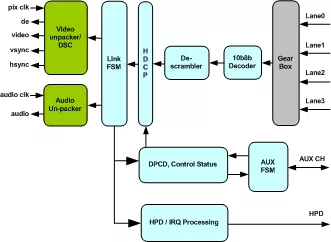
Block Diagram

Benefits

  • Single site license option is provided to companies designing in a single site.
  • Multi sites license option is provided to companies designing in multiple sites.
  • Single Design license allows implementation of the IP Core in a single FPGA bitstream and ASIC.
  • Unlimited Designs, license allows implementation of the IP Core in unlimited number of FPGA bitstreams and ASIC designs.

What’s Included?

  • The eDP Receiver interface is available in Source and netlist products.
  • The Source product is delivered in plain text verilog. If needed VHDL,SystemC code can also be provided.
  • Easy to use Verilog Test Environment with Verilog Testcases
  • Lint, CDC, Synthesis, Simulation Scripts with waiver files
  • IP-XACT RDL generated address map
  • Firmware code and Linux driver package
  • Documentation contains User's Guide and Release notes.

Specifications

Identity

Part Number
eDP Receiver IIP
Vendor
SmartDV Technologies
Type
Silicon IP

Files

Note: some files may require an NDA depending on provider policy.

Provider

Learn more about Displayport IP core

VESA Adaptive-Sync V2 Operation in DisplayPort VIP

In a computer system, both the GPU as well as the monitor have a certain rate at which they render or update an image, respectively. The rate is nothing but the frequency at which the image is refreshed (updated in the image it shows/displays), usually expressed in hertz, and can vary based on the content displayed on the screen.

DisplayPort 2025: Navigating the Next Wave of Display Innovation

This article breaks down the latest DisplayPort trends, the key technological shifts driving the protocol forward, and the strategic challenges implementers need to navigate — especially as DisplayPort IP finds its way into increasingly safety-critical domains.

Audio Transport in DisplayPort VIP

DisplayPort uses Secondary Data Packets (SDPs), which are transported over the Main-Link that are not main video stream data. This allows it to carry audio and video simultaneously. The VIP supports audio transmission both in the original mode as defined in the specification as well as just as any other SDP being transmitted.

Frequently asked questions about DisplayPort IP cores

What is eDP RECEIVER IIP?

eDP RECEIVER IIP is a Displayport IP core from SmartDV Technologies listed on Semi IP Hub.

How should engineers evaluate this Displayport?

Engineers should review the overview, key features, supported foundries and nodes, maturity, deliverables, and provider information before shortlisting this Displayport IP.

Can this semiconductor IP be compared with similar products?

Yes. Buyers can compare this product with similar semiconductor IP cores or IP families based on category, provider, process options, and structured technical specifications.

×
Semiconductor IP