Overview
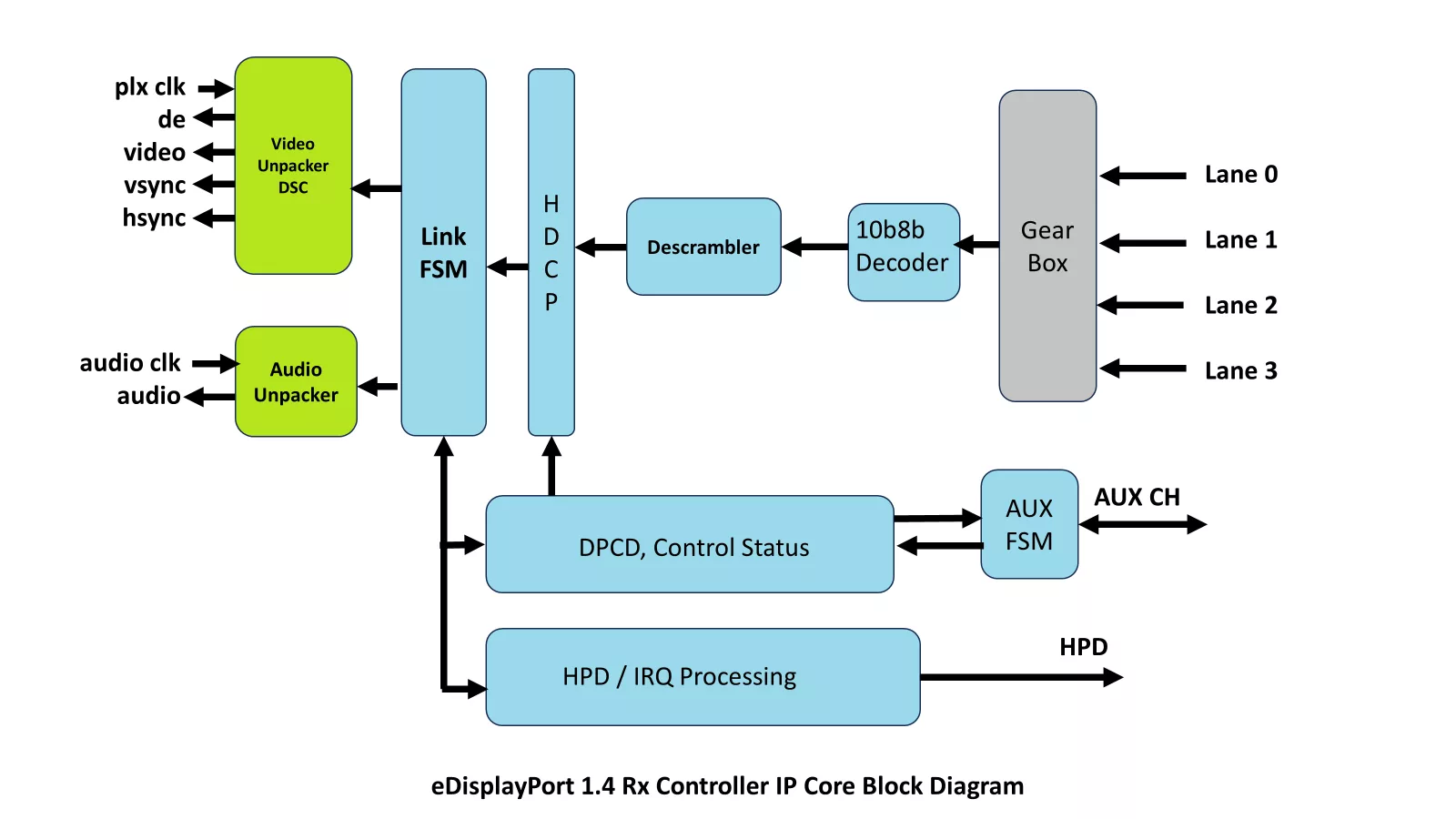
This eDisplayPort 1.4 Rx Controller IP Core is a versatile and comprehensive solution designed for easy integration into any SoC or FPGA development. It supports the eDP 1.4b specification and can be implemented in any technology, making it highly adaptable for various design needs. With a wide range of host bus interfaces, including AHB, AHB-Lite, APB, AXI, AXI-Lite, Tilelink, OCP, VCI, Avalon, PLB, Wishbone, or custom buses, it seamlessly integrates into any design architecture. Delivered in Verilog RTL, the eDP Receiver IP Core can be implemented in either ASIC or FPGA, offering flexibility in hardware choices. The IP has been validated using FPGA, ensuring its reliability and performance in real-world scenarios. The comprehensive package includes RTL code, test scripts, and a test environment for streamlined simulation. This eDisplayPort Rx IP Core is a feature-rich, user-friendly, and synthesizable design that empowers developers to effortlessly integrate it into their SoC or FPGA projects. With its support for eDP 1.4b, compatibility with various host bus interfaces, and flexible implementation options, it provides a robust solution for high-quality video and audio reception in electronic devices.
Learn more about Displayport IP core
T2M-IP, the global leader in semiconductor IP cores and technology expertise, is proud to announce the immediate availability of its partner's VESA-compliant DisplayPort v1.4 Rx PHY and Controller IP Cores.
T2M announces the availability of its partner’s Bluetooth V6.0 RF Transceiver IP Core in 22nm ULL and 40nm ULP.
Incorporating BroadR-Reach™ technology for Automotive Excellence, this PHY delivers exceptional performance for automotive and industrial applications, providing a superior alternative to traditional BaseT1 solutions.
Designed to meet the evolving needs of next-generation automotive and industrial applications, the CAN XL Controller IP offers superior performance and flexibility while maintaining backward compatibility with previous CAN standards.
T2MIP, a leading provider of semiconductor IP cores, proudly announces the immediate availability of their partner's H.264 and H.265 HEVC Codec IP cores.
T2M-IP is excited to announce that its state-of-the-art USB 3.0 IP, developed in the 22nm ULP (Ultra Low Power) and ULL (Ultra Low Leakage) process technologies, has been successfully licensed to over 10 customers worldwide in the past two years.