Overview
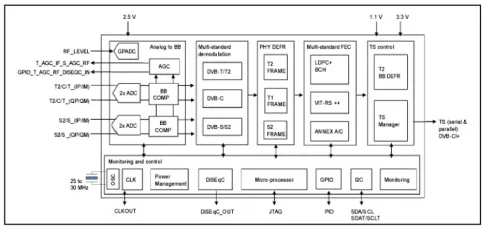
The is a single-chip DVB-T, T2, C, S and S2 demodulator IP core extratced from production chip and silicon proven IP core. Its Operation is exclusive in that only one signal (standard) can be processed at any time. The DVB-T2 demodulator features microcontroller assisted operation enabling the fast tracking and response times demanded by the T2 standard. For the T, C, S and S2 standards, where the demands for immediate response are much lower, classical software control from the host processor has been implemented. Even though the silicon implementation is highly optimized, allowing each standard to share common hardware blocks, effort has been made to maintain a common look and feel with the established product line. Optimization of the T2 microcode requires additional compilers which are, for the moment, supported exclusively by T2M. The DVB T, T2 and C demodulators share a common input which may be operated in ZIF mode or in IF mode. Silicon as well as traditional CAN tuners are supported through a flexible IF/baseband interface with IF/BB AGC and I2C control. A separate input is implemented for the DVB-S and S2 demodulators.This is single-channel tuner range is fully supported. Furthermore, the flexible ZIF IQ inputs, RF AGC and I2C allow the use of third-party tuner solutions when required.
Learn more about Modulation Demodulation IP core
T2M-IP, the global leader in semiconductor IP cores and technology expertise, is proud to announce the immediate availability of its partner's VESA-compliant DisplayPort v1.4 Rx PHY and Controller IP Cores.
T2M announces the availability of its partner’s Bluetooth V6.0 RF Transceiver IP Core in 22nm ULL and 40nm ULP.
Incorporating BroadR-Reach™ technology for Automotive Excellence, this PHY delivers exceptional performance for automotive and industrial applications, providing a superior alternative to traditional BaseT1 solutions.
Designed to meet the evolving needs of next-generation automotive and industrial applications, the CAN XL Controller IP offers superior performance and flexibility while maintaining backward compatibility with previous CAN standards.
T2MIP, a leading provider of semiconductor IP cores, proudly announces the immediate availability of their partner's H.264 and H.265 HEVC Codec IP cores.
T2M-IP is excited to announce that its state-of-the-art USB 3.0 IP, developed in the 22nm ULP (Ultra Low Power) and ULL (Ultra Low Leakage) process technologies, has been successfully licensed to over 10 customers worldwide in the past two years.