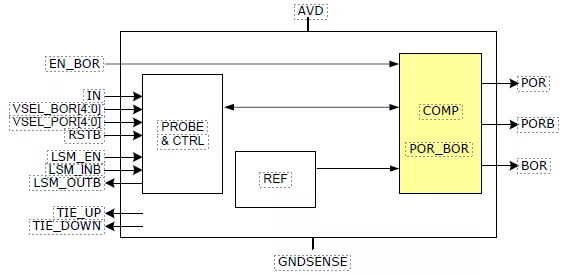
Learn more about Power On Reset (POR) IP core
Dolphin Semiconductor, a leading provider of semiconductor IP solutions, and INTERA Group, a semiconductor innovation company specializing in neuromorphic ASIC architectures, today announced a strategic collaboration to deliver a joint reference platform combining Dolphin’s WhisperExtractor (aMFCC) analog feature-extraction IP with INTERA’s Spiking Neural Network (SNN) processing architecture.
Perceptia Devices and Dolphin Semiconductor Partner to Deliver Best-in-Class IP Portfolio Covering Power Management, Clocking, High-Quality Audio and In-Situ Monitoring
Building on decades of expertise in mixed-signal IP, Dolphin Semiconductor has emerged as a trusted technology partner for global semiconductor players. Its ambition is clear: to become a leading actor in a market seeking reliable, scalable, and innovation-driven partners.
HCLTech, a leading global technology company, today announced a strategic partnership with Dolphin Semiconductor, a pioneer in low-power semiconductor IP, to co-develop energy-efficient chips.
Dolphin Semiconductor will provide a high-performance DC-DC converter in 40nm to XHSC for use in high-end industrial applications, reinforcing its position as a trusted partner in the semiconductor market.
Vertex Growth is a growth-stage venture capital fund anchored by Vertex Holdings, a subsidiary of global investment firm Temasek. The fund is dedicated to investing in high potential companies on the cusp of scaling-up.