Overview
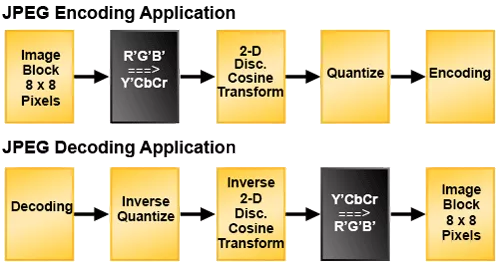
Color Space Converters (CSC) are used in video and image display systems including televisions, computer monitors, color printers, video telephony and surveillance systems. CSCs are also used in many video/image compression and processing applications, and in the implementation of NTSC/PAL/SECAM television standards, JPEG and MPEG systems. Color space conversion is required when transferring data between devices that use different color space models. For example, RGB to YCbCr color space conversion is required when displaying a computer image on a television. Similarly YCbCr to RGB color space conversion is required when displaying television movies on the computer monitor. As a color can be represented completely using three dimensions, a color space is a three dimensional space. Color space conversion is a one-to-one mapping from one color space to another color space.
Learn more about Image Conversion IP core
Lattice Prompt pairs with AI agentic tools developers already use, combining them with Lattice design tools, knowledge base, and documentation to turn natural language inputs into validated responses, dramatically accelerating FPGA development while optimizing design performance and capability.
First announced on May 4, 2026, the acquisition creates the industry's most complete secure management and control platform.
The acquisition brings together Lattice’s industry-leading low power FPGAs with AMI’s industry‑leading platform firmware and infrastructure manageability solutions for cloud and AI to create a complete portfolio of secure management and control solutions.
The collaboration demonstrates a real-time AI sensor fusion architecture that integrates TI mmWave radar and camera sensors using NVIDIA Holoscan Sensor Bridge running on Lattice’s low power FPGA. The FPGA acts as a companion chip delivering synchronized sensor data directly into GPU-accessible memory to enable low-latency and robust perception for robotics and industrial edge AI applications.
Sets new standard for secure control FPGAs with full CNSA 2.0-compliant post-quantum cryptography, crypto-agility, and hardware Root of Trust for next-generation infrastructure
Lattice Semiconductor today announced that the company expanded its small FPGA portfolio with new, high I/O density options in the Lattice Certus™-NX FPGA and Lattice MachXO5™-NX FPGA device families.