Color Enhancement IP
The Color Enhancement IP modifies or emphasizes color by controlling Saturation/Luminance/Hue.
Overview
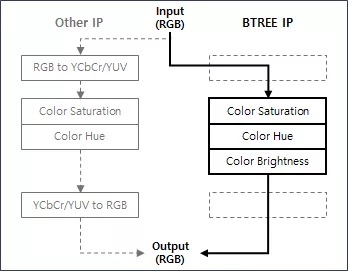
The Color Enhancement IP modifies or emphasizes color by controlling Saturation/Luminance/Hue. The Color Enhancement can only adjust the color & brightness of the specific area that user wants. Therefore, no change in other regions due to color adjustment of each area.
Key features
- Configurable Maximum Display Resolution
- FHD/QHD
- 2 BUS / 4 BUS of Interface
- 10 bit of Bit Processing
- 12 Region Color Control
- △ S, △ H, △ L Control at Each Region
- Hue Adjustable Range
- Max 240 °, Min 0.177°
- Saturation/Luminance
- Max gain x 15.99
- Global/Local Control
- Optimized for Power Saving
Block Diagram
Benefits
- RGB->RGB
- No Color Space Conversion
- No Color Truncation Effect
- Small Gate Size
- Easy to Tune
- Small Calculation Error
- Power Saving
What’s Included?
- IP Specification
- Encrypted RTL Source Code IP Core
- Comprehensive Integration Guide
- Technical Support and Maintenance Updates
Specifications
Identity
Videos
Files
Note: some files may require an NDA depending on provider policy.

Provider
Learn more about Image Conversion IP core
Nextreme Structured ASICs: An alternative for designing cost-optimized ARM926EJ processor-based embedded systems
Video Messaging for ARM7-based Cellular Chipsets.
Configurable Processors for Video Processing SOCs
Generating High Speed CSI2 Video by an FPGA
Viewpoint: Opportunity to win on different design fronts
Frequently asked questions about image conversion IP cores
What is Color Enhancement IP?
Color Enhancement IP is a Image Conversion IP core from BTREE Co,LTD listed on Semi IP Hub.
How should engineers evaluate this Image Conversion?
Engineers should review the overview, key features, supported foundries and nodes, maturity, deliverables, and provider information before shortlisting this Image Conversion IP.
Can this semiconductor IP be compared with similar products?
Yes. Buyers can compare this product with similar semiconductor IP cores or IP families based on category, provider, process options, and structured technical specifications.