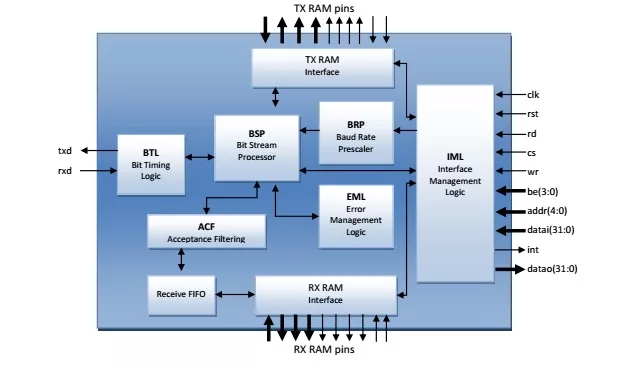
Overview
The CAN is a standalone controller for the Controller Area Network (CAN), which is commonly used in automotive and industrial applications. What's most important, the CAN conforms to the Bosch CAN 2.0B specification (2.0B Active). The Core has a simple CPU interface (8/16/32 bit configurable data width), with little or big endian addressing scheme. The CAN supports both standard (11 bit identifier) and extended (29 bit identifier) frames. Hardware message filtering and 64 byte receive FIFO, enable a back-to-back message reception with a minimum CPU load. The CAN is described at RTL level, allowing target use in FPGA or ASIC technologies. The Controller Area Network (CAN) is a advanced serial communications protocol developed by Robert Bosch GmbH. CAN protocol uses Data Link Layer and the Physical Layer in the ISO-OSI model. The CAN bus uses multi-master bus scheme with one logic bus line and equal nodes. The number of nodes is not limited by the protocol. Nodes do not have specific addresses. Instead, message identifiers are used, indicating the message content and priority of message. This also means that multicasting and broadcasting is supported by CAN. Number of nodes may be changed at run-time without disturbing the communication of the other nodes. CAN provides sophisticated error detection and error handling mechanisms and, due to differential transmission, high immunity against electromagnetic interference. Frames with errors are automatically retransmitted (except single shot transmission feature implemented in the CAN core).Maximum data transfer rate is 1Mbps at maximum 40 m bus length when using a twisted wire pair. The bus is handled with Carrier Sense Multiple Access / Collision Detection with Non-Destructive Arbitration. This means that collision of messages is avoided by bitwise arbitration, without loss of time. CAN controller is connected to host/CPU and CAN bus transceiver, which directly connects to CAN bus line (2-wire).
Learn more about CAN / CAN-FD / CAN-XL IP core
T2M-IP, the global leader in semiconductor IP cores and technology expertise, is proud to announce the immediate availability of its partner's VESA-compliant DisplayPort v1.4 Rx PHY and Controller IP Cores.
T2M announces the availability of its partner’s Bluetooth V6.0 RF Transceiver IP Core in 22nm ULL and 40nm ULP.
Incorporating BroadR-Reach™ technology for Automotive Excellence, this PHY delivers exceptional performance for automotive and industrial applications, providing a superior alternative to traditional BaseT1 solutions.
Designed to meet the evolving needs of next-generation automotive and industrial applications, the CAN XL Controller IP offers superior performance and flexibility while maintaining backward compatibility with previous CAN standards.
T2MIP, a leading provider of semiconductor IP cores, proudly announces the immediate availability of their partner's H.264 and H.265 HEVC Codec IP cores.
T2M-IP is excited to announce that its state-of-the-art USB 3.0 IP, developed in the 22nm ULP (Ultra Low Power) and ULL (Ultra Low Leakage) process technologies, has been successfully licensed to over 10 customers worldwide in the past two years.