
What is Binary-FSK Demodulator?
Binary-FSK Demodulator is a Modulation Demodulation IP core from Zipcores Electronic Systems Engineering S.L. listed on Semi IP Hub.
BFSK_DEMOD is a precision Binary-FSK Demodulator IP Core based on a non-coherent receiver design.
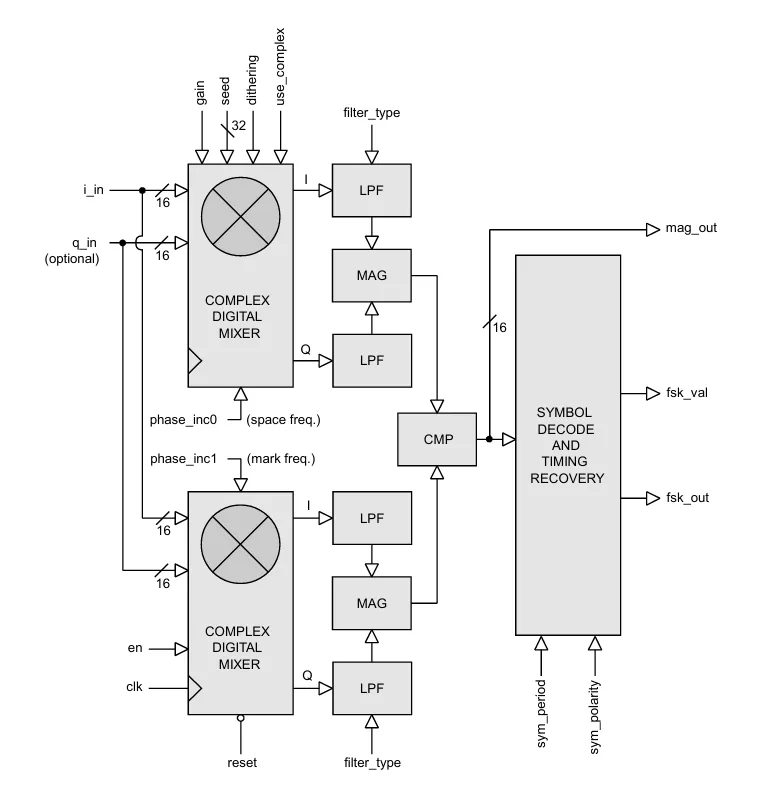
BFSK_DEMOD is a precision Binary-FSK Demodulator IP Core based on a non-coherent receiver design. The demodulator is fully programmable, allowing for a varied range of symbol rates and mark/space tone frequencies. Input data samples may be either complex or real for support of either passband or baseband signals. The module allows easy connectivity to an external ADC with up to 16-bit signed input samples.
The mark and space tone frequencies are generated by a pair of precision local oscillators. Each oscillator is implemented as a DDS with an SFDR of better than 80 dBs and a theoretical SNR of approximately 100 dBs.
After mixing, the I and Q signal paths for each tone are filtered to remove components above the mark and space centre frequencies. The characteristics of these filters may be changed depending on the desired FSK signal bandwidth.
A power function is used to compute the relative magnitudes of the mark/space tones after filtering. These magnitudes are then compared and passed to the symbol decode and timing recovery circuit. The signal mag_out is a 16-bit signed output that allows the user to monitor the magnitude of the output symbols before decode and timing recovery.
The demodulated FSK bit-stream appears at the output fsk_out. Bits are valid on the rising edge of clk when fsk_val is high.
Note: some files may require an NDA depending on provider policy.
Binary-FSK Demodulator is a Modulation Demodulation IP core from Zipcores Electronic Systems Engineering S.L. listed on Semi IP Hub.
Engineers should review the overview, key features, supported foundries and nodes, maturity, deliverables, and provider information before shortlisting this Modulation Demodulation IP.
Yes. Buyers can compare this product with similar semiconductor IP cores or IP families based on category, provider, process options, and structured technical specifications.