Vendor: CAST Category: Protocol Bridge

APB5 to APB4 bridge

The APB-BRG enables communication between an APB5 Requester and an APB4 Completer.

Overview

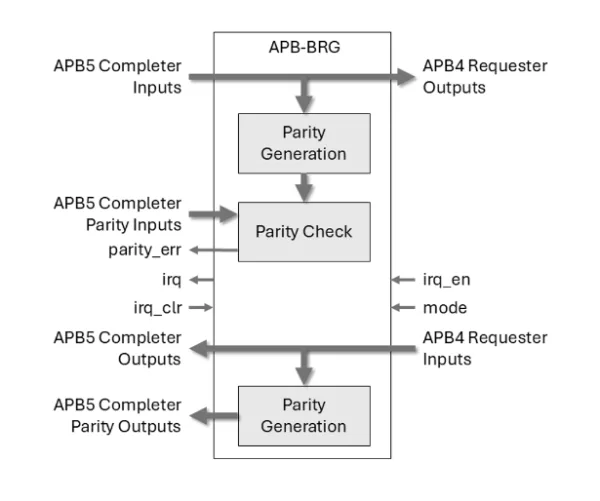
The APB-BRG enables communication between an APB5 Requester and an APB4 Completer. The core is designed for minimal latency and area, with its main functions including calculation of check signals from the APB4 interface and parity checking of signals sent by the APB5 interface.

The bridge also adds PWAKEUP, PNSE, and PUSER outputs to the Completer and offers configuration options to suit different applications. Error handling behavior is programmable for each APB signal independently, including the option to either terminate or propagate the transmission upon detection of an error on each parity signal.

The APB-BRG also implements a set of maskable interrupt lines for each APB parity signal independently.

Key features

  • Calculation of Requester parity signals.
  • Parity checking for Completer parity signals.
  • Minimal latency: 3 clock cycles between Completer and Requester.
  • Addition of PWAKEUP, PNSE, and PUSER signals as passthrough.
  • Registered signals on the APB5 interface.
  • Bus width options:
    • 2N data bits, where 2 < N < 11.
    • 1 to 32 address bits.
    • Configurable number of user bits.
  • Parity error output line per APB signal.
  • Configurable error behavior per APB signal through mode input:
    • Terminate transfer and disable core.
    • Continue transfer after error reporting.
  • Maskable interrupt lines for parity errors per APB signal.

Block Diagram

Applications

The APB-BRG is used when two APB interfaces of different versions need to communicate, specifically an APB5 Requester and an APB4 Completer.

What’s Included?

Deliverables

The core is available in synthesizable HDL (Verilog) and includes everything required for successful implementation. Its deliverables include:

  • Complete test environment.
  • Simulation and synthesis script.
  • Comprehensive user documentation.

Support

The core as delivered is warranted against defects for ninety days from purchase. Thirty days of phone and email technical support are included, starting with the first interaction. Additional maintenance and support options are available.

Specifications

Identity

Part Number
APB-BRG
Vendor
CAST
Type
Silicon IP

Files

Note: some files may require an NDA depending on provider policy.

Provider

CAST
HQ: USA
CAST is a silicon intellectual property (IP) developer, aggregator, and integrator providing IP cores and subsystems since 1993. Our product line features both leading-edge and standards-based digital IP, including compression engines and image processing functions; 8051 microcontrollers and low-power 32-bit BA2X™ processors; industry-leading automotive interfaces; a complete family of SoC security modules; and a variety of peripherals, interfaces, and other IP cores. Our goal is to maximize IP benefits for our customers by delivering high quality, easy to use, cost effective solutions for real system development challenges. We minimize customer risk through rigorous development standards, complete deliverables with comprehensive documentation, and superlative customer support. We maximize customer value thorough competitive pricing and simple licensing—including royalty-free options—and long-term partnerships with all leading silicon providers and select technology leaders. Our product standards and business practices have been uniquely honed through successful projects with hundreds of systems designers since the very beginnings of the IP industry, making CAST one of the best IP partners available.

Learn more about Protocol Bridge IP core

Keep Legacy Systems Running with a DO-254 HDLC & SDLC Part Replacement IP Core

One not-so-glamorous but vitally important use for CAST digital IP cores is to replace obsolete parts. Many of our cores can provide the answer if you’re maintaining a legacy system and need to make your own FPGA for a discrete part that was discontinued years ago, or perhaps consolidating a working but ancient board design into a single new chip.

8051s in Modern Systems: Interfacing to AMBA Buses

Despite being 40 years old, 8051 microcontrollers can still serve useful roles in modern systems. But integrating 8051s in today's systems with their de facto standard AMBA® buses, wider datapaths, and shared memories can seem impossible. Yet it can be done. Here we take a look at the challenges, and how to overcome them.

Using a Versatile, Independent IP Platform for SoC Design

This paper shows how companies adopting an IP platform approach can maximize the benefits of their investment by choosing a flexible, versatile platform suitable for a variety of projects. Major points to consider are illustrated through one such platform, the PIP-AMBA from CAST

Accelerating SoC Development with Agnisys Silicon IP Portfolio Automation

Modern System-on-Chip (SoC) designs are becoming increasingly complex as they integrate multiple processors, accelerators, memory subsystems, and peripherals. Ensuring efficient communication between these components requires a robust set of interface IPs, interconnects, and protocol bridges. However, designing and integrating these components manually can significantly increase development time,  integration challenges, late‑stage bugs, and pressure on already‑stretched engineering teams.

Frequently asked questions about Protocol Bridge IP cores

What is APB5 to APB4 bridge?

APB5 to APB4 bridge is a Protocol Bridge IP core from CAST listed on Semi IP Hub.

How should engineers evaluate this Protocol Bridge?

Engineers should review the overview, key features, supported foundries and nodes, maturity, deliverables, and provider information before shortlisting this Protocol Bridge IP.

Can this semiconductor IP be compared with similar products?

Yes. Buyers can compare this product with similar semiconductor IP cores or IP families based on category, provider, process options, and structured technical specifications.

×
Semiconductor IP