
BandGap V/I Reference Generator
CT20307 is an accurate reference voltage generator.
Overview
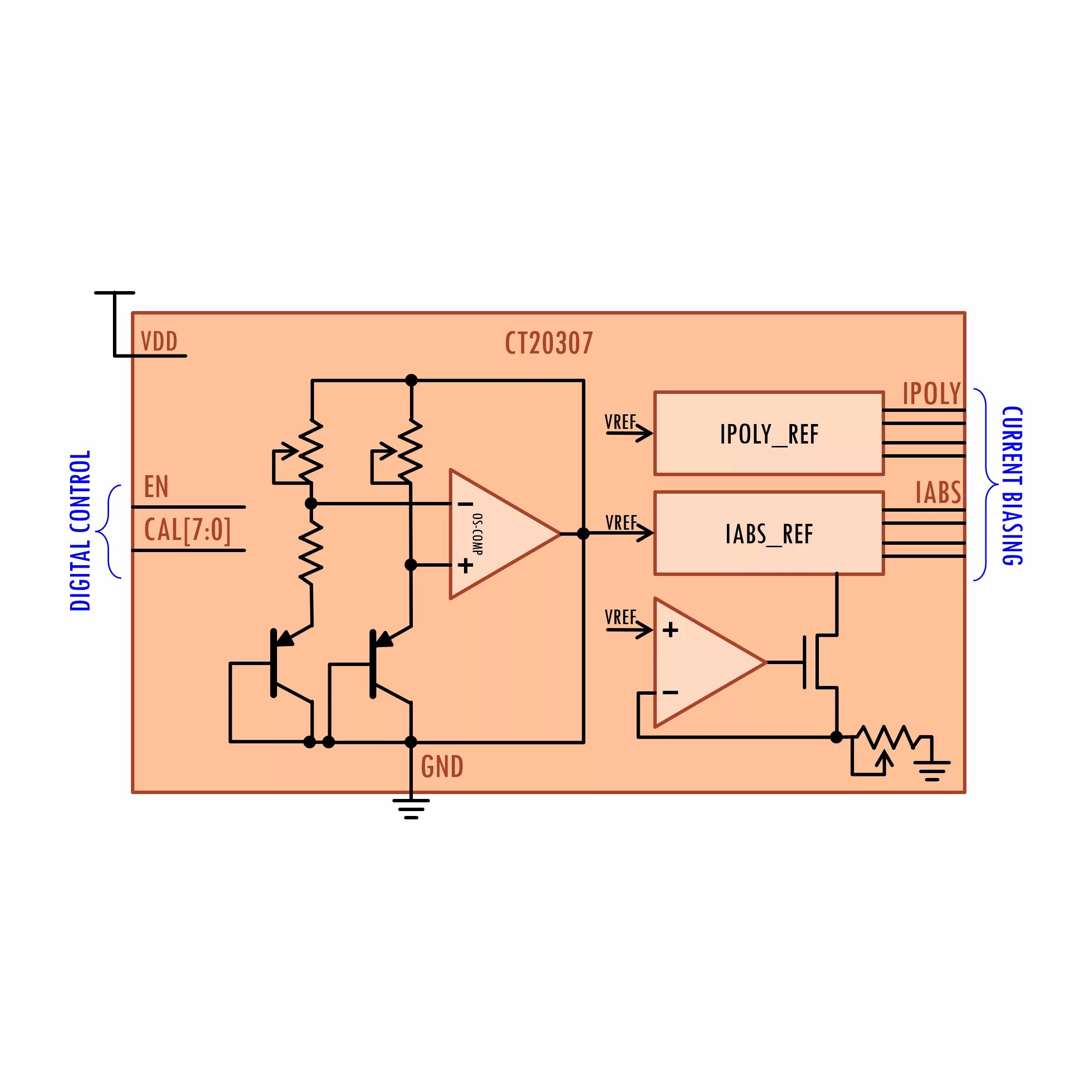
CT20307 is an accurate reference voltage generator. In order to achieve a total error <2%, the amplifier in the bandgap core block implements an offset cancellation circuitry.
Reference voltage thermal drift is minimized by means of 4 bits trimming so that the voltage reaches the “golden point”. CT20307 includes reference currents generators, both using an internal accurate 4-bits trimmed resistor.
Key features
- VDD = 3.3V
- Reference Voltage at VREF = 1.2V
- Reference voltage accuracy: ±2%
- 4 bits trimming for Reference Voltage, 4 bits trimming for Reference Current
- Reference currents: 10µA ± 10%
- Operating temperature: -40°C ÷ 125°C
Block Diagram
Applications
- Automotive Ethernet
- Baseband Telecom
What’s Included?
- Datasheet
- Integration guidelines
- GDS2 and LVS Netlist
- Footprint (.LEF)
- Test Specifications
Specifications
Identity
Files
Note: some files may require an NDA depending on provider policy.
Provider
Learn more about Voltage Reference IP core
Analog and Power Management Trends in ASIC and SoC Designs
How to specify and integrate successfully a measurement analog front-end including its power computation engine in an energy metering IC
Silicon Qualified SuperViC: the only way to safe SoC integration
Multiplexed Energy Metering AFEs Ease ASIC Integration and Provide Significant Cost Reduction
Analog IP Reuse in Nano Technologies
Frequently asked questions about Voltage Reference IP cores
What is BandGap V/I Reference Generator?
BandGap V/I Reference Generator is a Voltage Reference IP core from Canova Tech Srl listed on Semi IP Hub.
How should engineers evaluate this Voltage Reference?
Engineers should review the overview, key features, supported foundries and nodes, maturity, deliverables, and provider information before shortlisting this Voltage Reference IP.
Can this semiconductor IP be compared with similar products?
Yes. Buyers can compare this product with similar semiconductor IP cores or IP families based on category, provider, process options, and structured technical specifications.