Overview
We provide a robust lighting control technology based on the globally interoperable Bluetooth mesh standard. Whether you are a component manufacturer, a facility manager, or an energy service company, you can easily deploy our solutions to strengthen your competitive advantage and create new revenue streams.
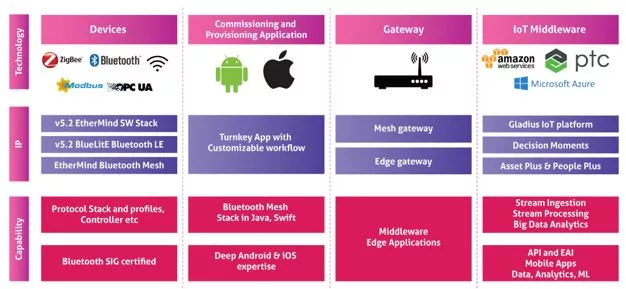
The Bluetooth wireless lighting ecosystem has Four main components
1. Bluetooth SIG Certified BLE Mesh
2. Commissioning and provisioning application
3. Multiprotocol IoT gateways that interfaces to third party BMS (Building Management Systems) / Cloud
4. Connected Building IOT Platform/Services
A technology platform that combines mobility, cloud and internet of things (IoT) can enable successful integration of existing infrastructure, including utilities, controllers/BMS, CCTV, ERP system, ticketing system and more.
Learn more about Bluetooth IP core
T2M-IP, the global leader in semiconductor IP cores and technology expertise, is proud to announce the immediate availability of its partner's VESA-compliant DisplayPort v1.4 Rx PHY and Controller IP Cores.
T2M announces the availability of its partner’s Bluetooth V6.0 RF Transceiver IP Core in 22nm ULL and 40nm ULP.
Incorporating BroadR-Reach™ technology for Automotive Excellence, this PHY delivers exceptional performance for automotive and industrial applications, providing a superior alternative to traditional BaseT1 solutions.
Designed to meet the evolving needs of next-generation automotive and industrial applications, the CAN XL Controller IP offers superior performance and flexibility while maintaining backward compatibility with previous CAN standards.
T2MIP, a leading provider of semiconductor IP cores, proudly announces the immediate availability of their partner's H.264 and H.265 HEVC Codec IP cores.
T2M-IP is excited to announce that its state-of-the-art USB 3.0 IP, developed in the 22nm ULP (Ultra Low Power) and ULL (Ultra Low Leakage) process technologies, has been successfully licensed to over 10 customers worldwide in the past two years.