Overview
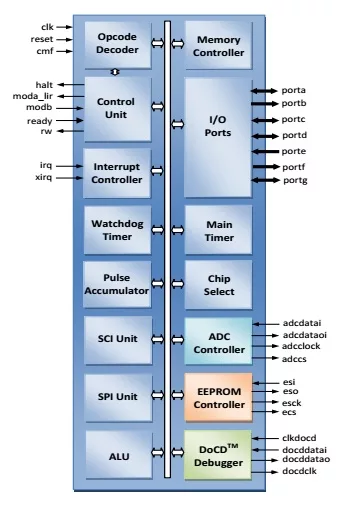
The DF6811 is an advanced 8-bit MCU IP Core, with highly sophisticated, on-chip peripheral capabilities. DF6811 soft core is binary-compatible with the industry standard Motorola 68HC11 8-bit microcontroller. It has an improved FAST architecture, that is approximately 4 times faster, compared to original implementation. In the standard configuration, the core has integrated on chip, major peripheral functions.
The Core can be provided in configurations, that match the following:
68HC11F/K
68HC08/05/11E/11F/K
MC6803/02/09/03/02
An asynchronous serial communications interface (SCI) and separate synchronous serial peripheral interface (SPI), are included. The main 16-bit, free-running timer system has three input capture and five outputcompare lines and a real-time interrupt function.
An 8-bit pulse accumulator subsystem can count external events or measure external periods. Self-monitoring on-chip circuitry is included, to protect DF6811E from system errors. A computer operating properly (COP) watchdog system protects against software failures. An illegal
opcode detection circuit provides a non maskable interrupt if illegal opcode is detected.
Two software-controlled power-saving modes -
WAIT and STOP are available, to conserve additional power. These modes make the DF6811E IP Core especially attractive for automotive and battery-driven applications. The DF6811E has a built-in real time hardware on-chip debugger -DoCDTM, allowing easy software debugging and easy package validation at each stage of SoC
design flow.
Learn more about MCU IP core
T2M-IP, the global leader in semiconductor IP cores and technology expertise, is proud to announce the immediate availability of its partner's VESA-compliant DisplayPort v1.4 Rx PHY and Controller IP Cores.
T2M announces the availability of its partner’s Bluetooth V6.0 RF Transceiver IP Core in 22nm ULL and 40nm ULP.
Incorporating BroadR-Reach™ technology for Automotive Excellence, this PHY delivers exceptional performance for automotive and industrial applications, providing a superior alternative to traditional BaseT1 solutions.
Designed to meet the evolving needs of next-generation automotive and industrial applications, the CAN XL Controller IP offers superior performance and flexibility while maintaining backward compatibility with previous CAN standards.
T2MIP, a leading provider of semiconductor IP cores, proudly announces the immediate availability of their partner's H.264 and H.265 HEVC Codec IP cores.
T2M-IP is excited to announce that its state-of-the-art USB 3.0 IP, developed in the 22nm ULP (Ultra Low Power) and ULL (Ultra Low Leakage) process technologies, has been successfully licensed to over 10 customers worldwide in the past two years.