
Vendor: NTLab Category: LDO Voltage Regulator

40 mA LDO voltage regulator (3.3/5.0V to 1.8V)

180TSMC_LDO_20 is LDO to convert IO voltage 3.0V÷5.5V to 1.8V and designed to supply integrated circuits with stable and precise …

TSMC 180nm BCDG2 Silicon Proven View all specifications

Overview

180TSMC_LDO_20 is LDO to convert IO voltage 3.0V÷5.5V to 1.8V and designed to supply integrated circuits with stable and precise voltage with load up to 40mA. 

The output voltage can be fine-tuned from +3% to  -4% at nominal value. 

The main feature of this LDO is ultra-low power consumption 1.2uA@VIN=5.0V at 5mA load current.

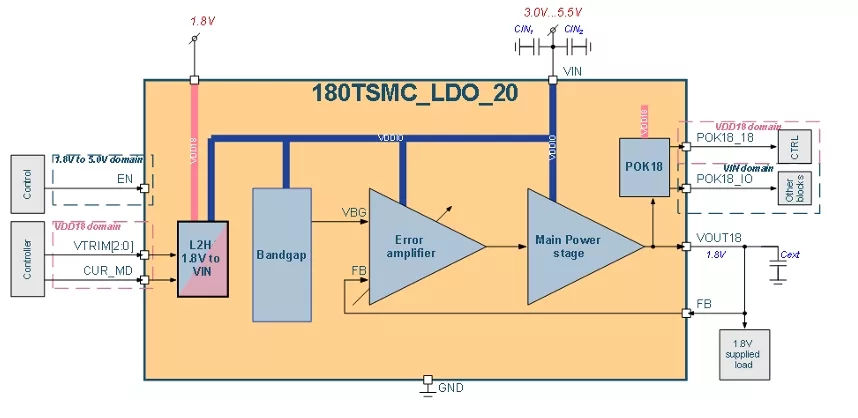
IP includes Bandgap voltage reference source as well as supplies LDO sub-blocks by PTAT reference current. There is Power-OK circuit to indicate a status about output voltage.

Key features

  • TSMC 180nm technology 
  • 1.8V output voltage
  • Output voltage trimming 
  • Maximum output load 40mA
  • Ultra-low quiescent current: 1.1uA@5.0V
  • Current boost mode to enhance load transient response 
  • Bandgap output voltage 0.9V (internal usage)
  • Analog IO supply voltage 3.0V to 5.5V
  • External load capacitor 1.0μF- 2.2μF
  • GDS area 0.181mm2

Block Diagram

Silicon Options

Foundry Node Process Maturity
TSMC 180nm BCDG2 Silicon Proven

Specifications

Identity

Part Number
180TSMC_LDO_20
Vendor
NTLab
Type
Silicon IP

Files

Note: some files may require an NDA depending on provider policy.

Provider

HQ: Lithuania

Learn more about LDO Voltage Regulator IP core

The Tradeoffs of Low Dropout (LDO) Voltage Regulator Architectures and the Advantages of "Capless" LDOs

Power management of battery-powered electronic devices is becoming increasingly more important for the microelectronics industry. This white paper details the difference between low dropout (LDO) voltage regulators that use external output capacitors and those that do not, and how your system designs can benefit from not using an output capacitor. Well-designed capless LDO voltage regulators can have multiple benefits, and they are presented here.

Power Management for Internet of Things (IoT) System on a Chip (SoC) Development

There are many factors that must be considered when developing a custom System on a Chip (SoC) for Internet of Things (IoT) applications. Chief among these are the power management circuits on the die. Vidatronic offers this white paper to discuss these considerations and all of the various circuit blocks that can be found in this application. Vidatronic IP solutions are discussed and the benefits they bring to IoT SoC designers.

Tradeoffs of LDO Architectures and the Advantages of Advanced Architecture "Capless" LDOs

Power management of battery-powered electronic devices is becoming increasingly more important for the present and future microelectronics industry. This application note details the difference between low dropout (LDO) voltage regulators that use output capacitance and those that do not and how your system designs can benefit from or be improved by not using an output capacitor.

Introduction to Low Dropout (LDO) Linear Voltage Regulators

Linear voltage regulators are key components in any power-management system that requires a stable and ripple-free power supply. A subset of linear voltage regulators is a class of circuits known as low dropout (LDO) regulators. This paper explains the fundamentals of LDOs and introduces Vidatronic’s LDO technology which solves many of the known shortcomings of LDO circuits.

Frequently asked questions about LDO Voltage Regulator IP cores

What is 40 mA LDO voltage regulator (3.3/5.0V to 1.8V)?

40 mA LDO voltage regulator (3.3/5.0V to 1.8V) is a LDO Voltage Regulator IP core from NTLab listed on Semi IP Hub. It is listed with support for tsmc Silicon Proven.

How should engineers evaluate this LDO Voltage Regulator?

Engineers should review the overview, key features, supported foundries and nodes, maturity, deliverables, and provider information before shortlisting this LDO Voltage Regulator IP.

Can this semiconductor IP be compared with similar products?

Yes. Buyers can compare this product with similar semiconductor IP cores or IP families based on category, provider, process options, and structured technical specifications.

×
Semiconductor IP