
3.4 to 11 MHz 8rd order low pass filter
The cell is the 8rd order Butterworth low pass filter with cut-off frequency adjustment.
Overview
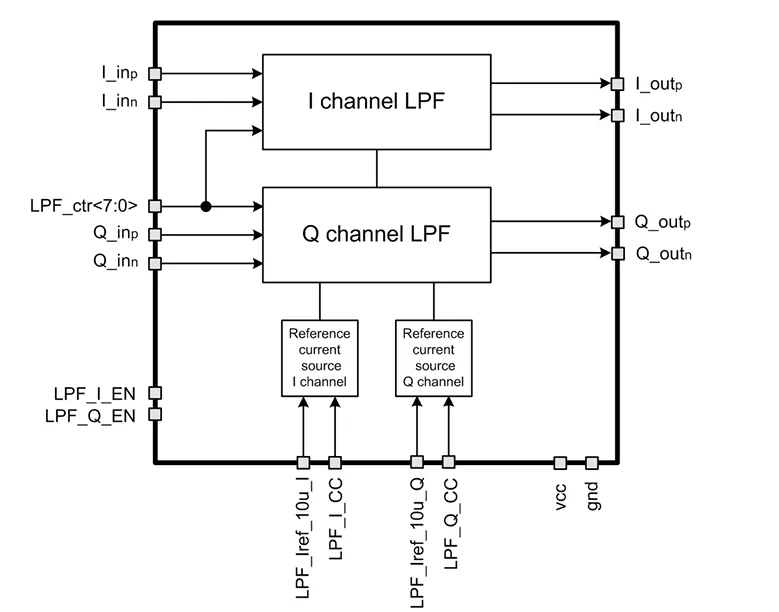
The cell is the 8rd order Butterworth low pass filter with cut-off frequency adjustment. The block has two channels of differential inputs and outputs and based on a pseudodifferential circuit and Sallen-Key circuit. CO frequency can be set by the digital code.
The block is fabricated on TSMC 0.18 um technology.
Key features
- TSMC BiCMOS 0.18 um
- Low noise figure
- High linearity
- Low pass filter cut-off frequency adjustment system
- Very low amplitude ripple
- Portable to other technologies (upon request)
Block Diagram
Applications
- Receivers
- IF signal processing
What’s Included?
- Schematic or NetList
- Abstract model (.lef and .lib files)
- Layout view (optional)
- Behavioral model (Verilog)
- Extracted view (optional)
- GDSII
- DRC, LVS, antenna report
- Test bench with saved configurations (optional)
- Documentation
Silicon Options
| Foundry | Node | Process | Maturity |
|---|---|---|---|
| TSMC | 180nm | BCDG2 | Silicon Proven |
Specifications
Identity
Files
Note: some files may require an NDA depending on provider policy.
Provider
Learn more about Filters IP core
Understanding cascaded integrator-comb filters
Revisiting the analogue video decoder: Brushing up on your comb filters
Opto-electronics -> Passive filters upgrade jitter testing
Ensuring reliability in Advanced IC design
The Architectural Evolution of 16GHz PLLs for Next-Gen AI and SerDes SoCs
Frequently asked questions about filter IP cores
What is 3.4 to 11 MHz 8rd order low pass filter?
3.4 to 11 MHz 8rd order low pass filter is a Filters IP core from NTLab listed on Semi IP Hub. It is listed with support for tsmc Silicon Proven.
How should engineers evaluate this Filters?
Engineers should review the overview, key features, supported foundries and nodes, maturity, deliverables, and provider information before shortlisting this Filters IP.
Can this semiconductor IP be compared with similar products?
Yes. Buyers can compare this product with similar semiconductor IP cores or IP families based on category, provider, process options, and structured technical specifications.