Vendor: NTLab Category: DC/DC Converter

3.3V to 1.8V, 0.7A Step-down DC-DC converter

High-efficiency step-down DC-DC converter is targeted for operation from 3.3V input voltage.

Samsung 28nm FDS Silicon Proven View all specifications

Overview

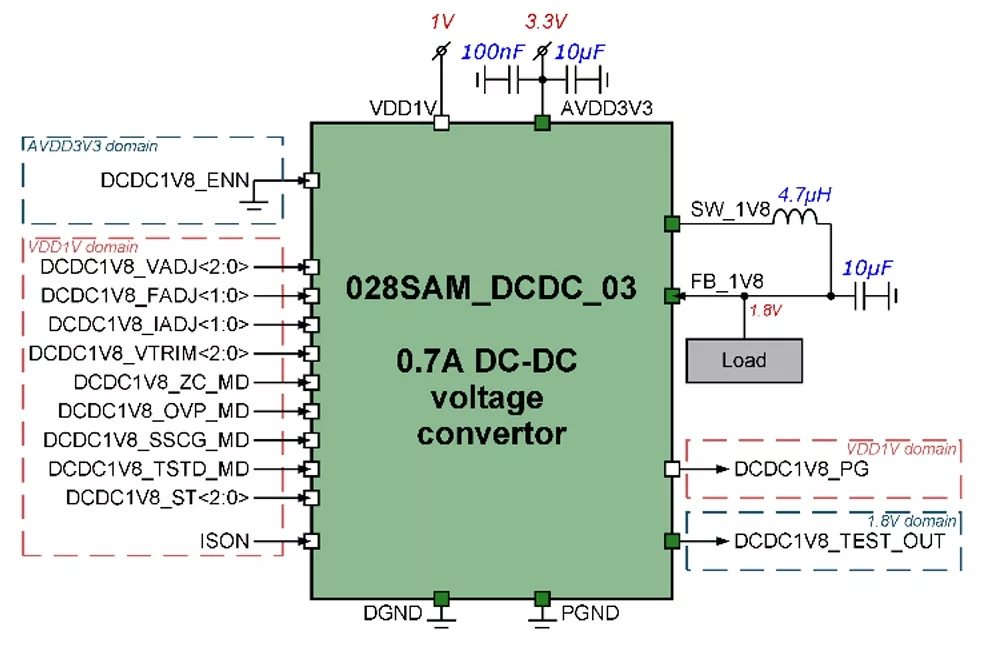
High-efficiency step-down DC-DC converter is targeted for operation from 3.3V input voltage. It is able to supply circuits with programmable output voltage 1.8V at 0.7A output current. The DC-DC converter contains overvoltage protection, and undervoltage-lockout circuit. During startup time DC-DC converter can operate both in the soft start mode, which provides the gradual increase of the output voltage and without it. The embedded Bias and LDO blocks provide a required voltage and current references to DC-DC sub-blocks.

Key features

  • Supply voltage: 3.3V analog and 1.0V digital
  • Adjustable output voltage with trimming: 1.75V÷2.05V (1.8V typical)
  • Output current 0.7A
  • Soft start mode
  • Undervoltage-lockout circuit
  • Overvoltage protection
  • Zero-cross detection
  • Oscillator frequency adjustment
  • Operating frequency modulation
  • Thermal-shutdown at 150°C
  • Embedded voltage/current reference source
  • Power conversion efficiency 87%@0.7A
  • Silicon area: ~0.93mm2

Block Diagram

Applications

  • Low-Voltage, High-Density Systems
  • Broadband, Networking, and Optical Communications Infrastructure

What’s Included?

  • Schematic or NetList
  • Abstract model (.lef and .lib files)
  • Layout view (optional)
  • Behavioral model (Verilog)
  • Extracted view (optional)
  • GDSII
  • DRC, LVS, antenna report
  • Test bench with saved configurations (optional)
  • Documentation

Silicon Options

Foundry Node Process Maturity
Samsung 28nm FDS Silicon Proven

Specifications

Identity

Part Number
028SAM_DCDC_03
Vendor
NTLab
Type
Silicon IP

Files

Note: some files may require an NDA depending on provider policy.

Provider

HQ: Lithuania

Learn more about DC/DC Converter IP core

Guide to Choosing the Best DCDC Converter for Your Application

This white paper introduces a procedure for choosing the proper DCDC switching converter for a given application. It explains basic, performance, and optional metrics in detail. It also demonstrates other practical aspects that are sometimes overlooked by system designers. Multiple application examples are provided.

How to simplify switch-mode DC-DC converter design

This article focuses on the design issues that are simplified by including an integrated inductor optimized for a range of electrical and layout applications as part of the power management solution

Breaking new energy efficiency records with advanced power management platform

The free lunch offered for decades by Moore’s law is now over and scaling down to the next technology node no longer offers the required energy efficiency gains. Design teams must now pursue their gains by deploying increasingly complex power management techniques to meet the demands of the new IoT markets.

Guide to Choosing the Best LDO for Your Application

To know which LDO you need, you must first define the application of your LDO and then examine which parameters are most important when dealing with that application. With the multiple parameters that characterize a particular LDO, it is not easy to determine which LDO is best suited. To help you figure this out, we have put together this reference. This guide presents a list of all the key LDO parameters along with their definitions, the most common applications of LDOs, and which parameters are critical for each.

Frequently asked questions about DC-DC Converter IP cores

What is 3.3V to 1.8V, 0.7A Step-down DC-DC converter?

3.3V to 1.8V, 0.7A Step-down DC-DC converter is a DC/DC Converter IP core from NTLab listed on Semi IP Hub. It is listed with support for samsung Silicon Proven.

How should engineers evaluate this DC/DC Converter?

Engineers should review the overview, key features, supported foundries and nodes, maturity, deliverables, and provider information before shortlisting this DC/DC Converter IP.

Can this semiconductor IP be compared with similar products?

Yes. Buyers can compare this product with similar semiconductor IP cores or IP families based on category, provider, process options, and structured technical specifications.

×
Semiconductor IP