24-bit Class-D Audio DAC, silicon-proven on GlobalFoundries 22FDX
Combines a 24-bit Sigma-Delta DAC, a multi-level PDM Class-D headphone amplifier and the surrounding digital filtering and control logic.
Overview
The mDAC115-CDA1-D.01 removes external components from your BOM and board area while keeping playback power in the milliwatt range. It is a complete audio playback path in a single Virtual Component.
It combines a 24-bit Sigma-Delta DAC, a multi-level PDM Class-D headphone amplifier and the surrounding digital filtering and control logic. The output stage drives 8 Ω headphones directly and differentially — no coupling capacitor, no output filter.
Implemented in 22FDX, validated in silicon
mDAC115 is implemented in the GlobalFoundries 22FDX platform and validated in silicon. This is not a paper port: the layout, characterisation and test chip work are done, and the full silicon report is available on request under NDA.
Dolphin has been a GlobalFoundries FDXcelerator partner since 2017 and has been shipping silicon-proven IP on the 22FDX platform ever since. For SoC teams targeting 22FDX for ultra-low-power wearables and hearing devices, that means an audio playback path you can integrate with a known risk profile and a predictable schedule.
Above 85% efficiency. What that does to a TWS battery
Dolphin's class-D family delivers above 85% efficiency at rated output. A linear output stage cannot. It dissipates the gap between the supply rail and the signal, and that gap is largest at the levels people actually listen at.
Zero external components in the audio path
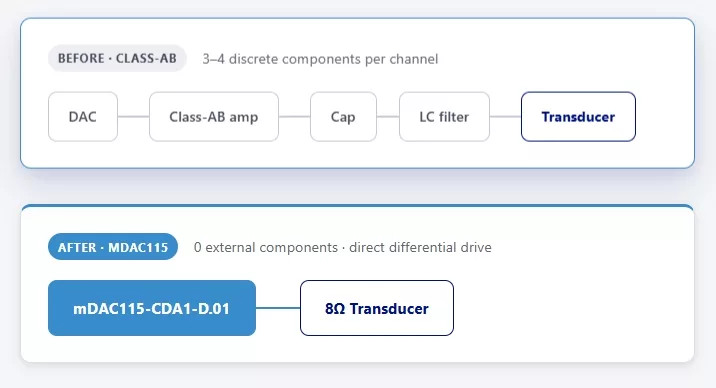
A class-AB audio output needs an amplifier, one DC-blocking capacitor, and in most designs an LC filter to keep switching noise off the antenna. That is three to four components per channel on the board. mDAC115 integrates the output stage and drives the transducer directly and differentially.
Key features
- Provide a top-tier performances audio DAC to fabless and IC companies willing to integrate audio features directly in their product and not using external IC
- High energy efficiency, ow power consumption,
- Ultra low latency for Active Noise Cancellation
- Embedded low noise voltage regulator for best resilience to power supply noise
- Inductor-less architecture for Low BoM costs and advanced system integration
Block Diagram
Benefits
- 1.8V analog power supply
- <2 uVrms output noise
- 2 µS latency
Applications
- True wireless stereo earbuds
- Wireless headsets
- Hearing aids & OTC hearing devices
- Smart glasses & AR/VR headsets
- Smartwatches & wearables
- ANC-enabled audio products
Silicon Options
| Foundry | Node | Process | Maturity |
|---|---|---|---|
| GlobalFoundries | 22nm | FDX | Silicon Proven |
Specifications
Identity
Analog
Files
Note: some files may require an NDA depending on provider policy.
Provider
Learn more about DAC IP core
Perceptia Devices and Dolphin Semiconductor Partner to Deliver Best-in-Class IP Portfolio Covering Power Management, Clocking, High-Quality Audio and In-Situ Monitoring
Dolphin Semiconductor Marks its First Anniversary with Major Expansion Push and Active Merge & Acquisition Strategy
HCLTech partners with Dolphin Semiconductor to develop energy-efficient chips for IoT and data center applications
Dolphin Semiconductor Provides High-Efficiency DC-DC Converter in 40nm to XHSC for High-end Industrial Products Applications
Vertex Growth commits €10M in Dolphin Semiconductor
Frequently asked questions about DAC IP cores
What is 24-bit Class-D Audio DAC, silicon-proven on GlobalFoundries 22FDX?
24-bit Class-D Audio DAC, silicon-proven on GlobalFoundries 22FDX is a DAC IP core from Dolphin Semiconductor listed on Semi IP Hub. It is listed with support for globalfoundries Silicon Proven.
How should engineers evaluate this DAC?
Engineers should review the overview, key features, supported foundries and nodes, maturity, deliverables, and provider information before shortlisting this DAC IP.
Can this semiconductor IP be compared with similar products?
Yes. Buyers can compare this product with similar semiconductor IP cores or IP families based on category, provider, process options, and structured technical specifications.