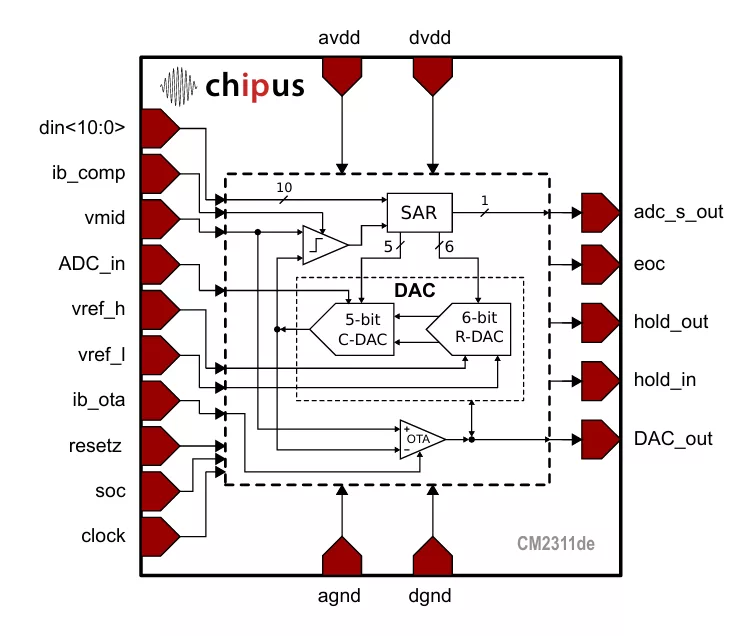
Learn more about ADC IP core
Chipus Microelectronics, a semiconductor company with proven expertise in the development of ultra-low-power (ULP) semiconductor IP, announced it has joined the GLOBALFOUNDRIES® (GF®) FDXcelerator Partner Program.
In order to come up with a successful product in the growing hearables/wearable market, the user experience is the most important aspect! We, as engineers, are supposed to solve problems to create a great end-user experience. This is key to successful products and this is the first premise that Chipus used to create this IP.
It is time for IP SoC 2020 Shanghai!!! We are looking forward to traveling and meeting people in person but it will not be possible during 2020. Because of COVID19, IP SoC 2020 Shanghai will also be a virtual event.
SiFive, the leading provider of commercial RISC-V processor IP, today welcomed Chipus Microelectronics, a semiconductor company with proven expertise in the development of ultra-low-power (ULP), low-voltage, analog and mixed-signal integrated circuits, to the growing DesignShare ecosystem. Through the partnership, Chipus will provide ULP IP for power management and ULP RF Front-Ends.
Chipus announces the tape-out of its 3rd generation of battery charger IP with several improvements when compared with previous versions.
Chipus is announcing the tape out of its Ultra-Low-Power IoT Analog IPs, targeted for SilTerra’s IoT platform, as part of the strategic partnership to provide analog IP solutions for customers.