CDM Dependence on Device Capacitance
This blog will focus on what happens during the CDM pulse itself, and will show how the pulse properties change as a function of DUT to Field Plate capacitance.
A Flipchip I/O Library with dynamitcally switchable 1.8V/3.3V GPIO, 5V I2C/SM- Bus ODIO, 5V OTP Cell, 1.8V & 3.3V Analog Cells an…
A Flipchip I/O Library with dynamitcally switchable 1.8V/3.3V GPIO, 5V I2C/SM- Bus ODIO, 5V OTP Cell, 1.8V & 3.3V Analog Cells and associated ESD.
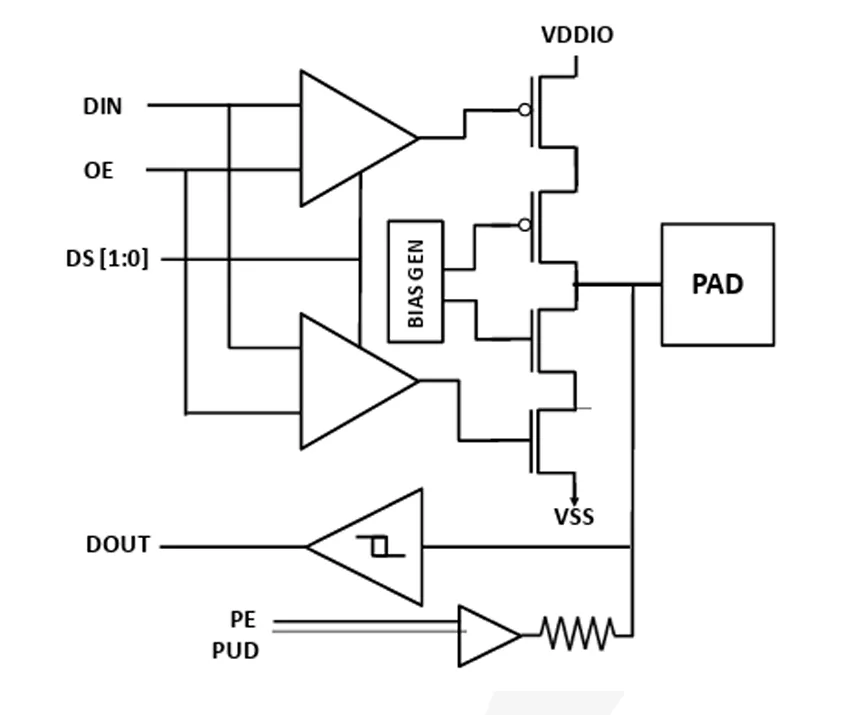
A key attribute of this library is its ability to detect and dynamically adjust to a VDDIO supply of 1.8V or 3.3V during system operation. The GPIO cell can be configured as input, output, open-source, or open-drain with an optional internal 50K ohm pull-up or pull-down resistor. Four selectable drive strengths are offered (25-235MHz @1.8V,10pF)to optimize across SSO currents & power. The output driver exhibits 50 (ś20%) termination across PVT to reduce reflections at higher operating frequencies. Supply cells for VDDIO, VREF, and core VDD include necessary built-in ESD circuitry. A 5V I2C / SMBUS open-drain (fail-safe) cell, 5V OTP programming gate cell and 1.8V & 3.3V analog cells with ESD protection are included. The library features protection break cells to allow for separate grounds while maintaining ESD robustness. ESD design targets are 2KV HBM, & 500VCDM,yet this libraryhas consistently demonstrated 4KV HBM. This library can also support 2KV IEC 61000-4-2 system ESD with appropriate integration.
Operating Conditions
| Parameter | Value |
| VDDIO | 1.8V/3.3V Selectable |
| VREF | 1.8V |
| Core | 0.8V |
| BEOL | 1P8M or 1P10M |
| Cell Size | 30x50um |
| Temperature | -40C to 125C |
| Max Load | 50pF (1opF at speed) |
Library Cell Summary
| Cell Type | Feature |
| GPIO | 25-235MHz, selectable |
| I2C ODIO | 5V, fail-safe |
| Analog | 1.8V & 3.3V |
| Supply/ESD | 1.8V/3.3V; 1.8V; 0.8V; GND |
| OTP | 5V progamming gate cell |
| Break Cells | VDDIO, VDD, VSS |
| Foundry | Node | Process | Maturity |
|---|---|---|---|
| TSMC | 16nm | 16nm 160 nm | — |
Note: some files may require an NDA depending on provider policy.

1.8V/3.3V I/O Library with 5V ODIO & Analog in TSMC 16nm is a Analog IP core from Certus Semiconductor listed on Semi IP Hub. It is listed with support for tsmc.
Engineers should review the overview, key features, supported foundries and nodes, maturity, deliverables, and provider information before shortlisting this Analog IP.
Yes. Buyers can compare this product with similar semiconductor IP cores or IP families based on category, provider, process options, and structured technical specifications.