Overview
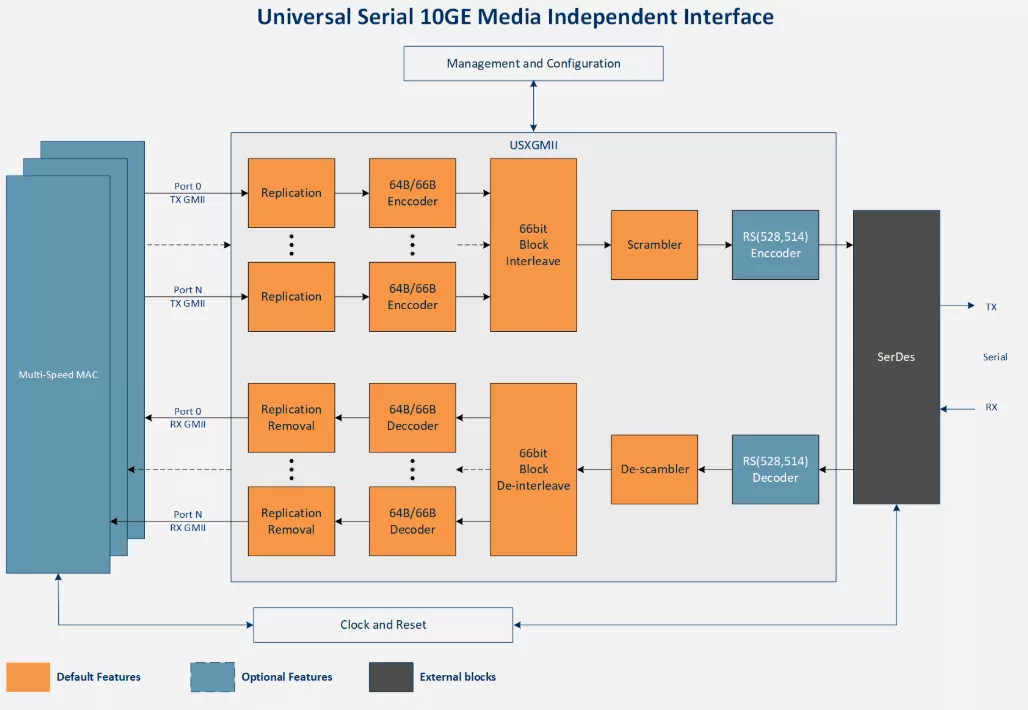
The USXGMII PCS IP provides the logic required to integrate a USXGMII-M IP into any system on chip (SoC). Link speeds of 5G, 10G, or 20G are supported. Compliant with the Cisco Universal SXGMII Interface for multiple Multi-Gigabit Copper Network Ports and IEEE 802.3 Clause 49 standards, the PCS IP has several optional features to customize the physical coding sublayer (PCS) for the specific needs of any application.
There are options to include support for RS-FEC forward error correction (RSFEC), as per IEEE 802.3 Clause 108, and access to control and status registers through an APB interface.
The PCS IP is engineered to be quickly and easily integrated into any SoC, and to connect seamlessly to a demultiplexed MAC through multiple XGMII (32-bit data, 4-bit control, single clock-edge interfaces). Connection to the SerDes is through a configurable 16, 20, 32, 40, or 64-bit interface.
Learn more about Single-Protocol PHY IP core
UniversalFlash Storage (UFS) was created for mobile applications and computer systems requiring high performance and low power consumption. These systems typically use embedded Flash based on the JEDEC standard eMMC. UFS was defined by JEDEC as the evolutionary replacement for eMMC offering significantly higher memory bandwidth. The standard builds on existing standards such as the SCSI command set, the MIPI Alliance M-PHY and UniPro as well as eMMC form factors to simplify adoption and development.
In this paper, we introduce a new high-level, dataflow programming language called C~ (“C flow”) that further increases productivity by raising the level of abstraction from behavioral descriptions, while overcoming the limitations of C for hardware design. We present the syntax and semantics of this language, and the framework that provides hardware and software code generation. This paper illustrates the benefits of using C~ for hardware design of a IEEE 802.3 MAC, synthesized for FPGA and for 90nm CMOS technology.
Universal Flash Storage (UFS) was created for mobile applications and computer systems requiring high performance and low power consumption. These systems typically use embedded Flash based on the JEDEC standard eMMC. UFS was defined by JEDEC as the evolutionary replacement for eMMC offering significantly higher memory bandwidth. The standard builds on existing standards such as the SCSI command set, the MIPI Alliance M-PHY and UniProSM as well as eMMC form factors to simplify adoption and development.
Since MIPI and MDDI standards both target interfaces to cameras and displays on mobile devices, are two separate standards really needed?
Enter the Inner Sanctum of RapidIO: Part 1
Networking software key to PICMG 2.16 optimization