UCIe D2D Adapter Explained: Architecture, Flit Mapping, Reliability, and Protocol Multiplexing
Understand the role of the UCIe D2D Adapter in enabling reliable, scalable, multi-protocol die-to-die communication for chiplet architectures.
Industry , Silicon Proven, 32 Gbps per pin, backed by a portfolio of verification tools, PHY interoperability and integration.
Industry Leading, Silicon Proven, 32 Gbps per pin, backed by a complete portfolio of verification tools, PHY interoperability and integration.
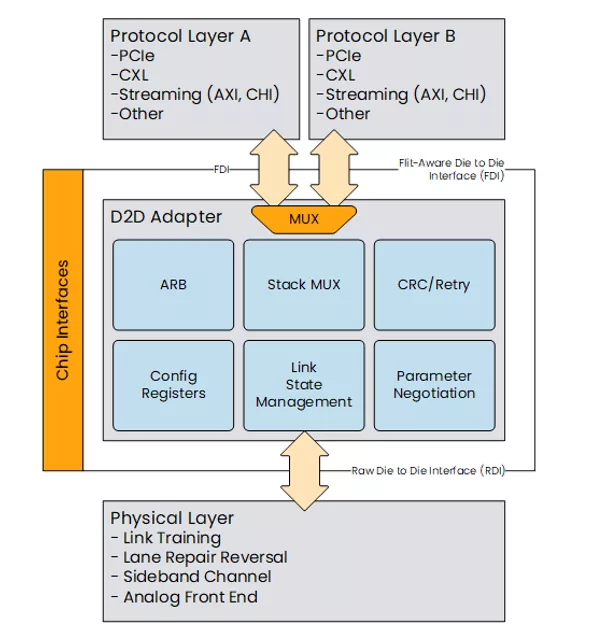
The D2D Adapter for UCIe is a scalable adapter layer between one or more protocol components and the UCIe PHY, which ensures efficient data transfer across the UCIe Link by seamlessly coordinating with the Protocol Layer and Physical Layer. By minimizing logic on the main data path, it delivers a low-latency, optimized pathway for protocol Flits. When handling CXL protocol, the D2D Adapter incorporates ARB/MUX functionality to support multiple simultaneous protocols. For scenarios where the Raw BER exceeds 1e-27, it implements the CRC and Retry scheme defined in the UCIe Specification, ensuring reliable data transport for PCIe, CXL, or other protocols including Streaming protocols.
Additionally, the D2D Adapter manages critical functions such as higher-level Link state machine coordination, parameter exchanges with remote Link partners for protocol options, and power management synchronization when supported. The IP Core is silicon and PHY agnostic implementation of UCIe D2D Adapter following the v2.0 standard, targeting ASIC applications. The IP core is thoroughly tested in System Verilog random regression environment.
The IP comes with the widest parameter set available and has gone through extensive testing. The IP core is silicon proven, heavily tested in UVM regression environment and has been interoperability tested and integrated with a leading UCIe PHY provider.
The Die to Die Adapter IP interfaces to the UCIe Serdes with the Raw Die to Die Interface (RDI) and to the Protocol Layer with the Flit-Aware Die to Die Interface (FDI). The IP is highly customizable and contains blocks for CRC / Retry logic as well as Protocol and Stack Multiplexers
Note: some files may require an NDA depending on provider policy.

UCIe D2D Adapter is a UCIe IP core from Chip Interfaces ApS listed on Semi IP Hub.
Engineers should review the overview, key features, supported foundries and nodes, maturity, deliverables, and provider information before shortlisting this UCIe IP.
Yes. Buyers can compare this product with similar semiconductor IP cores or IP families based on category, provider, process options, and structured technical specifications.