Vendor: Cadence Design Systems, Inc. Category: I2C / I3C

Simulation VIP for MIPI I3C

In production since 2015 on dozens of production design.The Cadence® Verification IP (VIP) for MIPI® I3Csm VIP provides support f…

Verification IP View all specifications

Overview

In production since 2015 on dozens of production design.

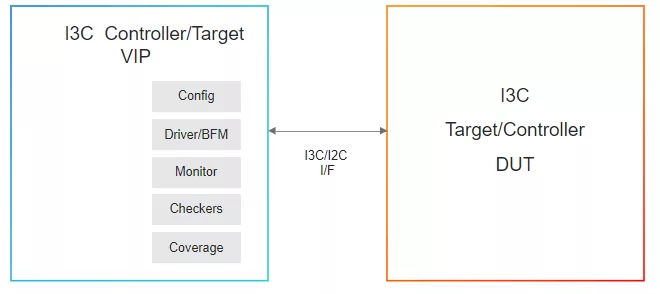
The Cadence® Verification IP (VIP) for MIPI® I3Csm VIP provides support for the MIPI I3C protocol specification. It provides a mature, highly capable compliance verification solution that supports simulation, protocol checking, coverage collection, and analysis, making it applicable to intellectual property (IP), system-on-chip (SoC), and system-level verification. The VIP for I3C helps you reduce time to test, accelerate verification closure, and ensure end-product quality. The VIP runs on all major simulators and supports SystemVerilog and e verification languages along with associated methodologies, including the Universal Verification Methodology (UVM) and Open Verification Methodology (OVM).

The I3C Specification describes the I3C interface (Improved Inter Integrated Circuit), which is used for easing sensor system design architectures by providing a fast, low-cost, low-power, two-wire digital interface for sensors.

Supported Specifications: MIPI I3C specification v1.0, v1.1, and v1.01. MIPI I3C Basic specification v1.0 and I2C specification.

Key features

  • I3C SDR Mode
    • SDR private read/write data transfers
  • I3C HDR-DDR Mode
    • HDR-DDR enter and exit patterns, command coding, bus turnaround, DDR Flow Control Elements and error detection
  • I3C HDR-Ternary Modes
    • Supports HDR-TSP and HDR-TSL modes including Data Transfer Ending Procedure Control (ENDXFER) and Ternary Flow Control Elements
  • I2C Legacy Mode
    • Supports I2C-only mode to simulate the I2C protocol as defined in the I2C specification
  • I3C CCC
    • Mandatory and optional CCCs: Direct and broadcast commands
  • Secondary Controller
    • Supports processing Secondary Controller controller role requests
  • Target Agents
    • Supports any number of I3C and I2C targets up to the limit of the specification
  • In-Band Interrupt
    • Supports processing of In-Band Interrupts from I3C targets
  • In-Band Hard Reset
    • Supports processing of In-Band Hard Reset
  • Arbitration
    • Supports I3C address arbitration
  • Hot Join
    • Supports hot-join procedure for adding targets to the bus on the fly
  • Dynamic Address Assignment
    • Supports the mandatory dynamic address assignment mode including SETDASA, SETAASA (v1.01 feature).
  • SDR Error Detection and Recovery
    • Supports SDR error detection and recovery methods for I3C Controller and I3C Target devices, including S0 error detection and S0/S1 error recovery mechanism
  • Target Response Control
    • Implements user control of target response fields such as data, target busy, target sending NACK, etc.
  • I2C 50ns Glitch Filter
    • Supports optional 50ns glitch filter for I2C devices
  • I2C Clock Stretching
    • Supports I2C stretching
  • I2C Start Byte
    • Sending of optional start byte in transactions is available
  • I2C Speed Modes
    • Standard, Fast, Fast Plus, Ultra Fast, and High Speed
  • I2C 7-bit/10-bit Addressing
    • Configurable option to use for target addressing
  • I2C Multi Manager
    • Supports I2C multi manager feature
  • Group Addressing
    • Supports this feature where Controller can send transaction on multiple targets at the same time using Group Addressing
  • Target Reset
    • Supports new target reset pattern introduce in V1.1
  • Monitoring Device Early Termination Capability
    • Supports feature where target which is not participating in transaction can terminate the transaction
  • Device to Device Tunneling
    • Supports target to target transfer
  • HDR Bulk Transport Mode
    • Supports HDR BT Mode where bulk transfer of data can be done
  • Multi lane Data Transfer
    • Supports multi lane for SDR, HDR DDR, HDR BT modes, multi lane for HDR TSP is under development

Block Diagram

Files

Note: some files may require an NDA depending on provider policy.

Specifications

Identity

Part Number
Simulation VIP for MIPI I3C
Vendor
Cadence Design Systems, Inc.
Type
Verification IP

Provider

Cadence Design Systems, Inc.
HQ: USA
If you want to achieve silicon success, let Cadence help you choose the right IP solution and capture its full value in your SoC design. Cadence® IP solutions offer the combined advantages of a high-quality portfolio, an open platform, a modern IP factory approach to quality, and a strong ecosystem. Now you can tackle IP-to-SoC development in a system context, focus your internal effort on differentiation, and leverage multi-function cores to do more, faster. The Cadence IP Portfolio includes silicon-proven Tensilica® IP cores, analog PHY interfaces, standards-based IP cores, verification IP cores, and other solutions as well as customization services for current and emerging industry standards. The Cadence IP Factory provides you with an automated approach to the customization, delivery, and verification of SoC IP. As a result, you can spend more time on differentiation, with the assurance that you'll meet your performance, power, and area requirements. Choosing Cadence IP enables you to design with confidence because you have more freedom to innovate your SoCs with less risk and faster time to market.

Learn more about I2C / I3C IP core

From I2C to I3C: Evolution of Two-Wire Communication in Embedded Systems

The I2C (Inter-Integrated Circuit) Bus invented in 1980 by Philips Semiconductors (NXP Semiconductors today) was a massive step forward in simplifying communications in embedded systems. It is a simple two-wire interface for synchronous, multi-master/multi-slave, single ended serial communication. Fast forward 45 years to today and it is still widely used for attaching low speed peripheral Integrated Circuits (ICs), processors and microcontrollers. But silicon today has changed...

Maximizing the Usability of Your Chip Development: Design with Flexibility for the Future

Early in my career selling chips for Motorola Semiconductor, the ability to spin derivative microcontroller chips for a customer’s specific requirement was relatively straightforward. If the volume looked reasonable, we would tape-out a new chip with a few added features because mask costs and wafers were relatively inexpensive at the larger process nodes. The customer won by getting an MCU tailored to their specific need, and Motorola won by gaining a more committed customer plus another SKU that could be sold to other customers – boosting ROI. With the migration to higher cost FinFET nodes, those times are long gone as the economics no longer work.

MIPI CCI over I3C: Faster Camera Control for SoC Architects

Imagine a camera subsystem that responds in microseconds, consumes less power, and offers a more straightforward route to time-to-market. For SoC architects and IP integration teams, that vision is increasingly possible with MIPI Camera Control Interface (CCI) over I3C.

Frequently asked questions about I2C / I3C IP cores

What is Simulation VIP for MIPI I3C?

Simulation VIP for MIPI I3C is a I2C / I3C IP core from Cadence Design Systems, Inc. listed on Semi IP Hub.

How should engineers evaluate this I2C / I3C?

Engineers should review the overview, key features, supported foundries and nodes, maturity, deliverables, and provider information before shortlisting this I2C / I3C IP.

Can this semiconductor IP be compared with similar products?

Yes. Buyers can compare this product with similar semiconductor IP cores or IP families based on category, provider, process options, and structured technical specifications.

×
Semiconductor IP